Showing posts with label Avengers. Show all posts

Saturday, November 5, 2016

So, it's come to this...

Disclaimer #1: For any of my readers who may be actively avoiding US politics this election season, let me give you a trigger warning. This entry is going to be addressing a politically driven satire that pokes fun at both major party candidates. If that is not your cup of tea, I advise you to give this read a pass.

Disclaimer #2: I'm an intractable bleeding heart liberal and I'm totally in the tank for Hillary and will probably be more prone to noticing the Trump jokes than the Clinton ones. If you don't want to sit through someone taking glee in and/or analyzing social commentary about your candidate of choice, you may want to sit this one out.

For those of you who are still reading this, let's all be honest: the election season has been a bit of a bear and both parties have ended up with candidates that are not without their detractors from within their respective parties as well as from their traditional opposition. But for every dark cloud, there is a silver lining: political satire. Yup, nothing takes the sting out of a particularly unpleasant election cycle quite like all of us gathering together as one to heal by taking the piss out of our entrenched political system. And for that, Marvel has given us this little boon that is Vote Loki.

One thing I love about this book is that it's pretty apparent early on that it's extra-canonical. It's certainly set in the world and basic status quo of the artist formerly known as Earth-616, but there really only a scant few wonky continuity things you need to know going into this book:
1. This is not your father's Loki. In the past decade, Loki has been revived twice, once as a woman (although that didn't take), and a second time as a child (aka my favorite Loki). Kid Loki eventually magically aged up more or less to make him about the same age as Tom Hiddleston around the time of the first Avengers movie. These days, he straddles the fuzzy area between being an anti-hero and anti-villain, but I think you can sum him up best as being a character who uses villainous means with theoretically heroic altruistic intent.
2. Thor is a woman now. Don't worry, the actual son of Odin and Freyja/Gaea is still roaming around somewhere, but the actual person now worthy to lift and wield the enchanted uru hammer Mjolnir (and all the powers that go with it, including the superhero persona) is Thor's original love interest, Jane Foster. And it's slowly killing her. She has cancer and every time she becomes Thor, it undoes the effects of her chemotherapy.
3. Loki and Thor have a new half-sister from another company. In a dispute with Image Comics, Neil Gaiman was awarded the rights to winged warrior woman Angela and he allowed her to be brought into Marvel's pantheon of characters in a wacky timeline-wonky story. To better weave her into the universe (and don't ask me the fine details because I haven't gotten around to reading that story yet), it was revealed that Angela is their long-lost sister. She's basically a hyper-aggressive She-Ra wing wings.

Well, now that I've covered the basics, on with the story of Vote Loki. Years ago (no specific time is given because characters only age when editors and/or Franklin Richards wills it so), the Avengers donated a large sum of money to rebuild a neighborhood in NYC  that had been utterly pulverized following one of their epic battles. If only scenes like this were featured prior to the events of Civil War... I'm sorry but I know it's considered a contemporary bench mark for Marvel, but on a basic conceptual level it's just not that good in terms of logistics and solid character-driven motivation on either side of the divide.

I can't help but notice the character lineup. Cap, Iron Man, Black Widow, Wasp, and... the Hulk? Okay, the Hulk's presence here means this would have to be either very early days or very recent. I could quibble about the details, but I'd rather just skip all that and arrive at the conclusion that this is not in-continuity and the MST3K mantra is in full effect: it's just a comic book, relax.

That money never got where it was supposed to because NY Governor Hitt funneled the donation from the Stark Foundation into his election campaign. Yeah, we are two panels into this book and we are not holding back when it comes to pointing out the deeply skeavy practices we've learned of in recent years in which charitable donations don't end up helping who they're supposed to.

One of the people effected by this morally bankrupt decision was a young Nisa Contreras who couldn't be more than maybe a high school freshman based on her appearance. From here we have a time skip. The book describes it as "a few years later," which in my mind means "not many." Of course, Marvel's timeline is weird, so a few years gave the tween enough time to get a journalism degree and establish herself as a reporter for the Daily Bugle. Of course, when your titular character is a millennia-old deity, what qualifies as "a few years" may be relative.

Nisa doesn't pull her punches and it's a great way of establishing her character as our deuteragonist as she uses her journalistic prowess to publicly take down Governor Hitt, exposing his wrong-doing from her youth. I'm not going to pretend that she didn't have vested interest in seeing him get his comeuppance, but she doesn't seem to gain satisfaction with it. The juxtaposition of the past and present scenes implies that she does have an inherent sense of bias, but it also frames her as a social justice crusader. As much as I think the internet has maligned that expression, I think it's fitting. After all, I think, particularly when speaking in terms of US politics, we are culturally hard-wired to associate truth and justice... and the American Way, whatever that implies.

Sometime later, Nisa is on the presidential election beat and she finds herself in the Spin Room, where she befriends a fellow named Lucas who finds the idea of the Spin Room amusingly subversive and I envy Lucas for remembering a time when a Spin Room was a bit of a distasteful novelty and not the sad truth of our endemic suffering. Yeah, I can hardly remember the Before Time, but for the past 3-4 months I've had to live in a world where Trump has nearly constantly been spewing offensively bigoted incendiary remarks unashamedly, only to have to hear his talking heads explain what he really meant by his latest characteristic racist/islamophobic/jingoistic/xenophobic/misogynistic/politically obtuse statement. I miss those halcyon days...

Our two leading candidates are never named in the series. Marvel has a history of not naming the presidents, at least when they factor into a story instead of being mentioned off-hand, Despite this, they do resemble their real-world counterparts, at least in broad strokes and without playing into their caricatured features. Keep in mind, this book was first announced in March and hit shelves in June, which means that even while we were still in the thick of the presidential primaries, the creative team had the clairvoyance to know that Clinton would end up clinching the democratic nomination and the Republican candidate would be an old white guy. While they are never named, the secret service refer to them as "Enterprise" and "Buffalo." When elected, I plan to address Hillary as President Enterprise and I advise you to do the same.

Nisa, being an observant journalist, spots someone with a concealed weapon in the audience and manages to alert the audience just as a small cadre of Hydra agents reveal themselves. Before they have time to enact their mission, Lucas reveals himself to be our titular character, Loki. He employs irony, besetting magical gold snakes on them. Their bite puts the Hydra agents into a coma.

Now, keep in mind, this happened in the spin room of a presidential debate. There are cameras and reporters everywhere, and with the candidates having been whisked away by secret service agents, the media all train their focus on Loki. This does seem a little odd because you'd think the safety and security of the presidential candidates would be a top priority. On the other hand, this title has a pretty flippant attitude about both candidates and aren't all that fond of the media either, so I guess it's easy to write it off as the media would rather focus on a shiny thing rather than cover the two major party candidates if they can help it.

It's pretty clear that he's toying with them and being fairly coy, but at the same time he's being refreshingly transparent about who and what he is. When asked who he's voting for, he says neither, since they're both liars. Then he declares that if he were president, he'd lie to them brazenly and they'd love him for it. I fail to see the difference is between what he's suggesting he would do and what the candidates do, but this is the basis on which buzz around his campaign is formed, so you just have to roll with it. Throughout the book, you'll see his appearances on media outlets be met with approval from hoi poloi, but you'll notice that the audience we see skews pretty young, and very urban. They're reactions sound more like they want to buck the system or praise a rockstar. This book has some opinions about millennials and/or hipsters.

Despite claiming to not be interested in running for president, he's doing a press junket, including an appearance on J. Jonah Jameson's talk show. Yeah, for future reference, it's actually been a while since he's been the EiC of the Daily Bugle. Between now and then, he's had a stint as the mayor of NYC. Now, however, he's been reduced to being a paper-thin Rush Limbaugh/Bill O'Reilly analogue. The studio has the stripes of the American flag in the background, giving it that extra jingoist touch. And like any conservative talking head, he turns out to be a birther.

Of course. The joke is on him however as when Loki reincarnated, he was born with a US birth certificate. I vaguely remember Thor finding the reincarnated Loki in Paris, France. It's been a while since the Fraction run, so I may be wrong. Even if I am wrong, Loki has been magically aged up. He was maybe 12 before, then was aged up to be about 18-21, and yet the minimum age for US candidacy is 35, so I guess the actual qualifications don't matter in this book. Even so, I wonder how he'd go about proving his birth certificate's authenticity.

Basic logic aside, it is worth it to see Jameson get caught on national television looking like a fool. Worth it.

This public humiliation is cut short however when the show gets a call-in from who else but intrepid reporter, Nisa Conteras. And she is clearly not on #TeamLoki. Remember that fight the Silver Age Avengers had in her old neighborhood? Well, it just so happens that they were battling against none other than our man, Loki. Gasp! Twist!! As we've learned about Nisa, her job as a reporter is to take down everyone who ruined her childhood. And not even death and rebirth is enough to wipe the slate clean for her. However, it's incredibly fitting considering one of our real world analogues has spent the past few decades ruining the financial futures of contractors and his own employees while getting away scot free.

Loki magicks himself into her apartment, which I have to imagine left Jameson scrambling to fill the time until the commercial break, He want to have a candid tête-à-tête with her, even while she pulls a gun on him. I suppose a single woman in NYC needs to be able to protect herself, but on the other hand making her a gun owner keeps her from being a read as an completely liberal anti-NRA strawman.

He admits to her that he is planning to run, and asks her to visit his campaign headquarters to write a story about it. Despite her better judgment, she goes.

This really has to be a whirlwind campaign because he already has a building full of pollsters making cold calls. The building is called the Ophidia research center. Ophidia is latin for snake or serphent, by the way. That's a nice touch, since most people wouldn't make the catch. It's a dumb mistake because I think the writer assumes that all religions and cultures have the same connotations. No, the god of lies is not the same as the father of lies. He's not the devil, therefore has no association with snakes. The only snake in Norse Mythology is the World Serpent, which surrounds the world, swallowing its own tail until the end of the world. Sidebar: In the Marvel Universe, the World Serpent is a guy and technically Odin's great uncle... because choices.

And of course, there are protesters outside who are crazed out of fear of what a Loki presidency would look like and inside, the pollsters are also crazy because that's what happens when an on-again, off-again villain runs for office. With all that insanity, it only makes sense that Loki hired some protection, so his sister Angela (see above, re: new continuity) has been employed to run security.

Oh, and did I mention Loki is a woman now? Don't think too much about it and don't get too invested in female Loki. Basically, Loki took this form for the day in an effort to throw whatever he can at the wall and see what sticks. They could have done more with this considering how much gender has played into this campaign, but this book is really avoiding getting bogged down with actual issues. Why talk about that when you can settle for ragging on the political process itself? That being said, female-presenting Loki actually does look presidential, as opposed to his default form, who looks like a scruffy rockstar. My boyfriend and I can't seem to agree on who, he does have a late 80's glam affect to his appearance. Steven Tyler? Keith Richards? Steve Tyler?

I don't think Nisa had any intention of coming away from this visitation with anything but an excoriating article, which she sends to her editor with a headline of "Loki Will Burn Washington." Mainly this is because of the ramblings of one crazed pollster. However, she ignores the fact that Loki has some sound ideas about bolstering the economy by providing large businesses who stay stateside with an incentive. Of course, why would she be balanced when she has an ax to grind? I think publicly declaring on national television that she has a beef with him should have automatically disqualified him from covering this story.

That becomes a moot point however the following morning when she wakes to her phone blowing up and discovers that her article has been altered, now reading the headline, "Loki's Campaign Something to Get Excited About." She's barely found out about this change when there is a knock on the door and suddenly she finds herself face to face with Thor the Goddess of Thunder. This lady must seriously be getting tired of Asgardians dropping in before she has a chance to put on something other than sleep clothes.

The next issue opens up with Loki's political ad and then running commentary from a couple of conservative news pundits. I'd say their interaction is a babbling waste, but I think that's the joke. More importantly, when I watch Loki's commercial, all I can think of is the best meme of all time.

I don't know where this fits in the timeline because this was aired maybe a day and a half after Loki announced his candidacy. When we cut back to Thor and Nisa, it's right where we left them.

Thor is not happy, thinking that Nisa is working for Loki. And being extra-canonical, Thor gets to speak like her old-school bombastic quasi-Shakespearean self and it's delightful. When Nisa points out that Loki only changed her headline and Thor actually reads the severely anti-Loki article, she delivers my favorite line of the issue: "Wow. Indeed thou dost indeed burn him."

Thor departs but not without dropping a clue for Nisa to follow, which leads her to returning to Loki's headquarters. Of course she goes while Loki is out at a rally, which only adds to his rock-star status. And everyone seems to be out of the office, as she finds abandoned... save for the cultists in Loki-robes sacrificing a goat. I don't find this as upsetting as the scary looking temple situation Loki has set up in the back of his campaign headquarters. It's an office building and that chamber has to be at least two, maybe three stories high. It makes no sense. And now my brain hurts.

Nisa makes sure that it makes it to the news and we get another visit with the talking heads, this time we have a riff on all the times politicians get caught in a scandal. In previous years, this sort of thing would be career-ending (not necessarily the fact that his constituents are non-Christian, but the fact that their ritual would probably get animal rights/welfare groups galvanized into action). But like certain politician who have been caught on tape bragging about being a sexual predator, Loki seems to be made of Teflon. He pulls the "I'm a god" card, which again, wouldn't fly in other elections and would probably be grounds for a psych eval, but here it becomes a triumphant mic drop for his supporters.

In issue #4, Nisa is going to greater lengths to expose Loki, this time investigating the Hydra agents who just happened to strike at a debate Loki just happened to be attending. They have all recently woken up from their comas and were being transferred to a medium security facility. Nisa intends to go to their new location to interview them, but the truck transporting them just happens to end up crashing in a fiery accident. So much for that idea.

But wait, why is Angela at the scene of the accident? Hm...

She knows that Loki was responsible for the Hydra attack and dispatched Angela to dispatch his catspaws. but before she can snap a picture on her phone, Angela is gone.

Back in the bizarre alternate reality known as news media outlets, a grown woman posing as a journalist (and wearing a large silly bow in her hair) is reporting on the deaths of the Hydra agents and rhetorically asks-- on national television-- who can blame them for trying to kill presidential nominees.

Okay, that does it. What the hell is up with this book?
 I mean, seriously...

There are people laughing so I can't tell if this is supposed to be some sort of Daily Show parody or if this book really thinks that poorly of American TV journalism. Regardless, this lady then suggests that Loki "sends some prison buses" to the now Doom-free Latveria. She also says she misses having Doom there because at least the trains ran on time. Is this supposed to be funny or overt support of fascism? I am so lost...

The next thing you know, Loki is partaking in a debate at the Iowa State Fair (and pulling off "folksy" quite well), and charms the viewers even as he eats one of the most improbable snacks I have seen in a lifetime of eating things nobody in their right mind should attempt to eat (one day. I will replace that Yankee Candle, mom. I promise), and now I think my life won't be complete until I have a caramel apple onion ring cheeseburger cone.

His political rivals are going for the jugular because Latvaria has become the new buzz topic in the debate and Loki has spoken out both against "Buffalo" being too accommodating with them and Enterprise skyping with Doom's children. To be fair, Doom's kid Kristoff is an expatriate living in America last I checked, so he might actually be a viable social contact.

Loki explains that he will deal with Latvaria without risking a single American life. It is such a big shock that even Nisa puts her hunt for Loki's birth record on pause to hear his declaration as he declares the only right thing is to keep boots off the ground in Latvaria and that fighting will not resolve the problem. This is actually quite reassuring to everyone else.

Nisa on the other hand, had a different takeaway from that broadcast.
She immediately buys herself a flight to Latveria, which I assume is can only lead to good things. After all the only thing safer than a dictatorial state ruled over by a egomaniacal techno-wizard is 
a former dictatorial state that has been left utterly destabilized by the sudden removal of a long-standing oppressive regime.

She passes herself off as a member of one of the factions vying for control of Latveria. Elsewhere another faction is searching for one of Doom's special hidden weapons caches. A man leads them past the mystical security door and this guy is totally not Loki guys, I swear. No really, scout's oath. When the rebels come out armed, they are confronted with the armed forces of the current controlling regime and like a bunch of idiots, they use Doom's secret weapons without testing them first and the whole battle scene goes up in a puff of smoke. The man who couldn't possibly have been Loki turns into Loki and I can't help but read this like the end of a Bugs Bunny cartoon. Except that Nisa was in the right place at the right time to catch Loki expose himself on video.

This has already made the news before Nisa's plane lands in the states and the news outlets are dragging Loki across the coals. Of course, this book hates millennials and thinks they're stupid contrarians about everything and by the time Nisa arrives, the hipsters have become convinced that if the media hates Loki, he must be a real threat to their establishment and must therefore be the only candidate for them.

At this point, Nisa's about ready to give up.


By the time we open on our final issue, Nisa is looking to flee the country rather than abide by a Loki presidency. All the while, she watches footage of Loki being saved by a mentally unstable superhuman by Angela followed by whispering between the two. The next thing you know Angela has pulled out her phone and sets up a meeting with Nisa. Thor is there, as well. Apparently, the two had been in cahoots the entire time. Angela had been waiting for an opportunity to save Loki's life in order to compel him to tell her some crucial information... and she happily gives that information up to Nisa in exchange for a lifetime subscription to the Daily Bugle. It's the little things in life...

It turns out they are standing in the base of operations of the Hydra sect that attacked the debate and pulling up their computer revealed "Lucas From Buzzfeed" as their leader. Lucas? Remember him? That was Loki's disguise way back in the beginiing of the mini-series.

This gets published and of course, the millennials are completely fine with it because this book hates everyone too young to remember wondering about who shot Dallas, despite being comics' target demographic. It does however further galvanize the anti-Loki movement, causing the two opposing sides come to blows.

Chaos is erupting in the streets as Loki's fans have not been dissuaded (sound familiar, guys?) and the sitting president and congress even unanimously voted to strip the office of the president of many of its more recently acquired powers in anticipation of a Loki presidency.

Nisa is watching tenuous fabric of American life rip itself apart and the seams when there is a knock on the door and does she ever wear anything around the house besides booty shorts and a camisole? I'm guessing journalism pays the rent, but not the AC. Loki needs help-- he's doesn't want to be president, not if it means causing the nation to tear itself apart. He needs her help getting him get him discredited... which has worked so well in the past. Still, he promised not to tell a single lie in the process, and trickster deities know how sacred promises and deals are.

He instantly transports her to a live studio, changing her wardrobe in the process thankfully. He is expecting Nisa to ask all the best questions and expose him, although it's fairly obvious that he knows it would backfire, presumably to bring both sides of the aisle together in support of him. Nisa has a trick of her own however and causes and upset by handing the mic over to his supporters in the audience to ask questions, this apparently has not happened before. Not a single question has been asked by anyone other than the press. Unable to lie and unexpectedly confronted by his supporters, he's already been thrown two curveballs, However, as the questions go on, it seems like Loki has no concrete plan to address many of the problems facing the nation. Not only that, the supporters who thought he would buck the corrupt system are gobsmacked to find out he'd be working in the interests of all Americans, not just the rebellious fringe.

Nisa sums it up beautifully by asserting the only message his campaign has really delivered on was declaring "the other two candidates are bad" and that's not enough for any candidate to get even close to the presidency.

One particular audience member calls him out, feeling betrayed because Loki would rather work with the government than bring it down and Loki reaches his breaking point. You know when you're the oldest member of your social circle by a significant stretche and you finally have had enough of pretending to be cool and want to let your friends know what's what? Yeah, Loki has stopped being cool uncle Loki and calls his supporters out on the idiocy that has carried his campaign this far.

The next day is the election day and the only states that Loki ends up winning are Nevada, Nebraska, West Virginia, Mississippi, and New Jersey... because if any state will vote for someone who lies nearly all the time and treats everyone like they are morons, it's New Jersey (mwahahahaha.... Trump isn't the only one going down, Chris Christie).

We see a montage of celebration from our cast. Jane Foster in chemo looks up at the hospital television with a staid grin on her face while Angela celebrates alongside Rocket and Groot in the only bar in NYC that will serve the Guardians. Although, probably not for long since Angela's jubilant excitement causes a waitress's face to get smashed with a plateful of pie and drinks. Nisa gets tapped to appear on J Jonah Jameson's show on the Fact Channel and turns around to find Loki in her apartment. Again.

He's fairly certain he's going to lose, but he twists it into a win by suggesting that this whole story was all an overly elaborate ploy to give Nisa the chance to right the wrong that Loki caused in her childhood. Of course, she calls it for the slapdash bullshit it is, but it's more friendly than any interaction they've had thus far. Maybe it's because he's no longer a threat, or maybe it's because tricking him like she did took him down a peg enough for her to humanize him a bit, but this conversation feels genuine and less like the satirical posturing that much of the book has felt like. It's actually pretty charming.

Loki floats away as he pulls out a flip phone (he can join Cap in the anachronistic phone club) as he calls to concede to his winning opponent. Of course being Loki, he frames it like his blowup the previous night was a gift for his/her campaign. And he literally disappears into the horizon as the story ends.

This isn't a bad story by any stretch of the imagination. It's fun and moves at a good pace, but it feels unfocused. This book tries to do too much, mainly because it had too much of a good thing. There is a lot that goes into a US presidential election and this current one has been an insane cycle, so there was no shortage of material for them and in trying to genuinely capture what it feels like to be an American following the election process faithfully, the creative team ended up with a book that feels unbalanced and unwieldy in certain places. I also question the angle the satire took. The crux of Loki's campaign was because everyone thinks the candidates are so bad. We never learn why. They are super generic to the point that they could have been cardboard cut-outs. As a result, the focus of the sature becomes the inanity of the organ grinder monkeys TV news pundits and spending an incredibly large amount of time poking fun at the Bernie or Bust movement. Yeah, with all the material Trump's primary constituency has going for it, the book kept going back to the hipsters/millennial well whenever they wanted to lampoon the American public. And poking fun at millennials and the Bernie or Bust movement is fine, except for the fact that they seem to be the only ones targeted in this piece. I somehow suspect that the writers feared they'd get threats if they aimed their satire at the deplorables, and because of that I feel like the book doesn't have the courage of conviction needed to write truly spectacular social satire.

Wednesday, July 20, 2016

I'm not mad, I'm just disappointed

So, now that Crisis on Infinite Earths is out of the way, I suppose I'm probably morally obligated to finish up this arc of Uncanny Avengers, right? Sigh. I guess I brought this upon myself.

Well, the cover is a pretty fun switch up of a classic X-Men attack. I appreciate that it's on prominent display here. Despite Uncanny Avengers being the "Avengers/X-Men mashup" series, it has gradually reduced the presence of X-Members so that Rogue is only on this team to justify it. Despite long ties to the X-Books, Deadpool isn't an X-Man, let alone a mutant, and Cable is better known for being a solo hero or leading very fringe X-teams than he's known for being an X-Man proper, so seeing Rogue and Deadpool take on Colossus and Wolverine's respective roles for a Fastball special is a pleasure to see. Also, kudos to Stegman for playing to his strengths-- not a close-up of an unmasked face in sight.

A brief sidenote: Apparently, Marvel packages this arc into a trade under the name "Future Lost." Quite honestly, I think it was a grievous error on their part and I will continue referring to it as "Plant Apocalypse" and will accept no substitute.

If you'll remember the latter half of last issue, just after Quicksilver ran off to get an antidote to Human Torch, who is slumming with an MIT think tank, the Shredded Man used his toxins to KO most of the team except for Synapse, who is immune, and Cable, who took his vitamins. Cable sticks around to inoculate the rest of the team and sent Synapse out to confront the villain solo only to discover that he is in fact her own grandfather.

This issue starts off reminding us of last issue's newly revealed familial relationship between our rookie and our villain by cutting back to the prologue from the first issue of the arc. This is unnecessary. Marvel has been employing a recap page across the line for years. It's just the latter half of the scene where Shredded Man wakes up, but this time we see that it was Synapse in the other terrigen chrysalis. It really is a little pointless to the narrative. We learn absolutely nothing new about the characters in this scene nor does it help progress the narrative already in progress. They do cut to yet another chrysalis in the household and establish that there is yet another Inhuman in the family. Perhaps you could argue that this scene sets up story elements for a later arc, maybe, but I'd be quick to shoot that defense down. There is no drive, no dramatic question to this scene that the plot hook, which ought to be handled with a bit of subtlety feels more like a Hidden Pictures game in Highlights for Kids after someone already has circled the fish in the tree.

I am going to be so surprised when that brick the writers threw at us finally lands.
Duggan, do you mind if I call you Duggan? Good. Duggan, I know you're far more used to writing for Deadpool, and perhaps that explains why you've embraced this "sledgehammer to the head" approach to long game storytelling, but might I advise you remember that as a storyteller in a serialized format, as a dramatist, you need a far more deft hand in the writing stage. Make a scene that is utterly essential to the narrative before trying to be clever.

Okay, for a story that is just so "meh," I've already had a rant and we're only on page one. That doesn't bode well...

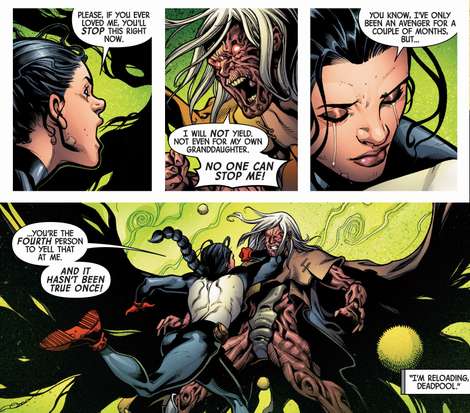
We transition to the present, where Synapse tries to hearken to her grandfather's better nature, but he doesn't see eye to eye. Apparently, that's enough to get Synapse from being very blubbery to being action girl because she's tired of people yelling at her today. She takes a swing at Shredded Man, but we cut away before we see if she manages to land the punch.
Yelling is all it takes to break the ties that bond.

Elsewhere, Cable has the rest of the team up and running again. Rogue and Deadpool perform a fastball special. Say whatever else you want about this comic, but you cannot say they failed to deliver what the cover promised us. Of course, this should be a big finisher attack, but it's being used to kill one of the many, many plant monsters that it feels more ostentatious than effective. Points for the nostalgia factor.
Oddball Special: Patent pending.
Deadpool calls out to Quicksilver, presumably they're on an intercom or Quicksilver is omniscient, and asks if the speedster can swing by his armory for some ammo. Instead, Quicksilver materializes with a guns as well as a local shop owner in tow. Apparently, in that nanosecond Quicksilver had time for a conversation with a gun-owner who is not a speedster, in which he insisted on coming along, then ferry the gun shop owner over to the battlefield. Ignoring the fact that this puts a civilian at gross risk when clearly there was the far more viable option of going to Deadpool's armory like he asked, it is also is an example of the writers not telling a story in which the mechanics of their heroes make any sense. Granted, this is a superhero comic in a shared universe with 60+ years of history. Inconsistencies are bound to happen. But there is a difference between inconsistencies in power levels and baseline humans being able to able to apparently mimic their abilities for no reason.

A Plant Apocalypse is not enough to deter fanboys.
Oh, wait. There is a reason. The guy is a Deadpool fan. I'm a little annoyed that Duggan felt the need to break the physical laws of its characters in order to support a... you know, I'm not even entirely certain that I'd call it a joke, but Duggan sure seems to think so. It's probably fair to point out that Duggan is one of the two current regular writers on Deadpool's eponymous book, so perhaps he got a little confused about which book he was working on.

Back at MIT, Quicksilver has returned to see about the cure that Johnny Storm's think tank has been cooking up and again I find myself asking why is Johnny Storm there? I'll give him props for having the idea to outsource the science portion of Marvel superheroism, but what purpose does he serve staying there? He has fire powers! Anybody who has played the starter battle of any Pokemon game can tell you that grass types are weak to fire. Either he is A. a world class slacker, B. an idiot, or C. the writers need a reason for this story to last the length of an average trade paperback.

Stand aside Emma. Pietro is the
OG Jerk Hero.
I will give Johnny Storm this, however: as Quicksilver speeds away, he gives a quick little monologue that gives me all the feels about our resident speedypants. Quicksilver is one of my favorites because he falls into one of my favorite paradigms: the jerk hero. He's smug, he doesn't play well with others, he's had a few turns as a reluctant and/or conflicted villain, but he has a lot of heart, is fiercely protective of his loved ones and tries to do what he thinks is right... even if that means convincing his sister into overwriting reality. Okay, nobody's perfect.


I am only now noticing how Stegman draws Pietro's super speed and honestly, it doesn't look quite right. I think he was aiming for a creative new approach to motion lines, but the actual result creates the impression that he has sprung tentacles from his back. It's not a dealbreaker, but it is certainly a bird that wasn't meant to fly.

Back in Boston, Cable suddenly gets a psychic vision of Synapse snapping her grandfather's neck. Oh, yeah. Two volumes of X-Force ago, Cable mysteriously gained a new ability in the form of precognition. About four years of publication later, I still don't know what is causing these insights, so I'll continue to assume it was the plot convenience fairy. Anyway, Cable's time traveler insight into the future lets him know that his precognitive insight in the future is bad, so he rushes off to stop Synapse from committing grand-patricide.

Before Synapse can snap her grandfather's plant neck (which I'm fairly certain wouldn't have killed him with his far more arboreal physiology), Cable leaps forth and knocks her away, warning that killing Shredded Man will ensure that the crisis doesn't end. As he breaks up them up, he overhears the part of the conversation that they are in fact related.

A strategically calculated dick move?
Why you are Scott Summers kid, after all!
Cable confronts our villain himself. Apparently, Shredded Man has read the villain's handbook because he expects Cable to announce that his plan will fail. However, since Cable is here specifically because his plan succeeded, he instead describes his process for developing a cure. In the process, he formed a sister strain of the original virus that removes the immunity to Inhumans. Shredded Man says he's prepared to die, but instead Cable shoots Synapse.

Um, I'm not the world's biggest fan of Cable by any stretch of the imagination, but that is coldblooded. He hears them mention they're related, asks for clarification to make sure he hadn't misheard (which actually detracts from the badassitude of this scene), then two minutes later, he shoots one of his comrades-in-arms point blank. You're a sick bastard, Dayspring!

Synapse twitches about on the floor as her grandfather's pestilence courses through her body. Still she manages to sputter out a patented guilt trip. And this is what causes her grandfather to realize he in fact still has the milk of (in)human kindness coursing through his planty veins. It's like the ending of Care Bears movie. He relents and all his plant apocalypse vanishes away. Yes, our crisis is wrapped up that neatly. It's about on par with breaking a spell with true love's kiss. The terrain completely returns to normal and Synapse (and presumably all his other victims) are cured.
Funny. Guerrero doesn't sound like a Jewish family name.

Synapse reaches out to her grandfather, offering to help him find a cure for what he has become, but he declares that when he "wiped the slate clean," he undid all that he had done, including his own body, which dissembles itself in front of her, saying he can make more. So, what that tells me is that it probably wasn't even the genuine article they were facing. He was just some plant golem. That feels so less impressive when it isn't a Doombot.
"You captured their stunt doubles!"

So that was our big climax, everybody. Such as it is. Oh, yeah. I know you hardly noticed it as this story didn't peak so much as it consistently fizzled from about the halfway point onwards. It's hard to tell when the tension is rising when all you have to decipher is a steady stream of "mehhhhhhhhhh."

Now, I'm all for an emotional climax as opposed to a big, punchy kick-kick battle, but this is not earned. Our creative team waits until the final page of the penultimate installation of the story to reveal a familial relationship between our antagonist and our team rookie, neither of whom, I might have had enough characterization done in order to make us feel invested in this revelation. All we really know is the former is a genocidal maniac and the latter feels very cagey about being on a team of superheroes. That's all we know going into this revelation.

I can't even care what this means for them as people, let alone what this means for the story. And yet Duggan hinges the end of the narrative on this.

Mind you, this could have worked. There were three issues leading up to this revelation. Three issues in which we could have taken a few minutes here or there in which to get into Synapse's head or even have another character ask her something personal. She was even on a date with one of her teammates, for crying out loud. But no. The creative team concluded that any time spent setting their characters up so that this wouldn't have felt like a forced plot twist was better served by killing Quicksilver only to bring him back immediately at the start of the next issue and giving Cable not one but two painfully drawn out introductions. This issue could have have a strong emotional impact on its own, but the creative team sabotaged itself by making the two middle chapters of their narrative extremely unfocused, with the third issue being mostly a waste. It takes the wind out the sails of  what honestly could have been a decent conclusion.

Well, let's wrap up this narrative.

As the team gathers around what was once the Shredded Man (or his plant golem), Synapse asks Cable to keep her secret, but doesn't know if he can. But he tries. Keep in mind, Cable isn't terrible by nature. He's just occupationally terrible.
Good guy Cable: he shoots you in the face but keeps your secrets.
Later, we cut to the rooftop where Captain Rogers has landed the helicopter on their base of operations. A helicopter? Yeah, it's kind of weird that the Avengers are flying around in anything besides a quinjet, but I think Iron Man lost his vast wealth over the eight month gap, so I guess that means a helicopter is their way of downsizing.

Rogers is once again refusing to accept Deadpool's letter of resignation, presumably because he's running out of team members with ongoing solo titles and he needs some way of keeping circulation of this book up with the the other three (minimum) Avengers titles.

Cable and Captain Rogers have a grizzled staring contest
and the rest of the world shudders in terror.
Synapse approaches him, looking pretty sheepish, asking to talk to him about something. Rogers kind of charmingly shoots her down, saying he doesn't have time to coddle her and Deadpool. Yeah, old Cap doesn't have the time for handholding that he'd normally have. Oh, well.

Rogers recruits Cable by telling him that the Unity Squad's secret mission is to find Red Skull and retrieve Xavier's brain. They stare at each other in a panel in which Stegman perfects his talent for making grizzled elderly men look horrifying.

The final splash of their story gives you the impression that this was a "getting the band together" story. You see the whole lineup together albeit, for some reason most of the team seems to be headed towards the rooftop door, but Johnny and Pietro have assumed lifeless stock poses. Again, Stegman should be drawing action figures for a living. Also, this wasn't a "getting the band together" story. This was a "getting Cable to front our shitty band" story. On top of that, two of the team members were markedly absentee throughout the entire story. Rogers and Johnny have not been through this adventure. They weren't part of this supposed story about them coming together as a team. They just fill up the ranks. You could argue that at least Johnny was contributing, even if it was a misuse of his talents, but all Steve Rogers, Mister huge shredded octogenarian, did in this story was drive the freaking chopper.
Is it just me or do they all look embarrassed to be here...
...except Deadpool?

So did he just melt off Ultron's face to
prove a point?
Epilogue. Yes, this monumental epic warranted an epilogue. In the far reaches of space, a crew of a space vessel that all look like they are dressed like locomotive engineers have just been rescued... from something. By whom is revealed as their airlock opens and we see the telltale lights of Ultron's faceplate. As their savior steps inside the headpiece melts away to reveal Hank Pym. Yeah, I thought he was dead. Guess not. I'm a little surprised though. Usually A-Listers have the self-respect to wait at least two years to come back from the great beyond. And I'm guessing he's made a version of Ultron (or retrofitted a previous version of Ultron) to be be a space suit.
I am just shaking my head. Don't get me wrong, I really like the idea of fusing these disparate parts of the Marvel Universe that don't exactly work together. As much as I hated the Remender run for making everyone overly dark and uncharacteristically confrontational with one another, at least I felt like the characters were in the hands of someone who had a grasp on what he wanted to do with them. I feel like Duggan and Stegman were handed this assignment a week before the deadline and were told to do whatever. And that's the only word I use to describe how I feel about this arc: whatever. It isn't incredible, nor is it utterly loathsome. It's filler. Make me love you or make me hate you, but make me feel nothing and that's how you fail as a form of art/storytelling.

Next week, I'm taking a trip on the cinematic way-back machine as I watch one of the most important superhero-inspired films of this or any other generation, Teenage Mutant Ninja Turtles 3.


Tuesday, June 28, 2016

Shit My Possibly Racist Time Traveling Mutant Grandpa Says

It's been a while since we checked in on the Unity Team, and I figure we're about due. My feeling on this title so far has been mixed. I admittedly have deeper ties as a reader to most of this lineup of characters than anything else I've written for the blog to date, but I've yet to feel more than okay about this book. Of course, compared to its previous two volumes, I can say I like it quite a lot, but on its own merits, it's only a solid "okay." Of course, at the end of last issue we saw the introduction of this team's sixth ranger, the man called Cable. Whether he proves to be this book's missing ingredient or a flavor that overpowers the rest of the team remains to be seen. Of course, naming the issue "Too Many Cooks" gives a good sense of where this is leading.

The cover is fairly straightforward. It's Cable. Holding a big freaking gun pointed in the reader's face. There really isn't much to elaborate on other than the fact that he has an Avengers insignia on his chest where he'd normally have an X badge. So, there's very little mystery whether or not he's joining the team. I do have to wonder why his body language has his legs spread so wide apart. I mean, he ends up in that pose a lot. Is it because those BFG's he carries around are so heavy that they lower his center of gravity or does he simply take manspreading to a new level?

The issue starts off with Brother Voodoo and Quicksilver. They're standing under a massive tree under the unearthly red skies of Boston. Pietro is bragging about how easily he took out the Shredded Man. If that doesn't sound at all the way things played out at the end of the last issue, then congratulations for paying attention.

Aw, Pietro's getting better at making friends...
Brother Voodoo is less than delicate in pointing out the discrepancy. As soon as he points out that Quicksilver didn't exactly survive that encounter, the next thing Quicksilver knows, he surrounded by the grasping hands of demons. Considering Marvel has long established that the appearance of hell / hell dimensions are subjective, and moments ago everything was honky dory for Quicky's afterlife experience, I'm just going to rule this sudden shift as being Brother Voodoo having a flair for the dramatic. In short order, Jericho pulls Pietro away from the throng of demons, pulls open the veil between this life and the next and they escape. Interestingly, as they flee, Voodoo tells Quicksilver not to look back. It feels very reminiscent of the story of Orpheus and makes me wonder whether Haitian mythology has a similar myth. Once they're gone, an ominous demonic voice says that Voodoo owes him a life and that he'll seem him/her soon.

As far as hellscapes go, this is underplayed, but effective. If you hadn't looked at the recap or read the previous issue immediately before this, the turn really can take you buy surprise and feels disturbing without feeling too graphic. It gives you just enough of a tease for the future story they're setting up here.
The afterlife are big believers in "take a penny, leave a penny."
Back in the land of the living, Deadpool is administering CPR to Quicksilver's body. Once revived,, I find it funny that Quicksilver is so used to the life of being a superhero that he doesn't even acknowledge Deadpool for his medically resuscitation, but thanks Brother Voodoo for his mystic mojo. He also asks what that  voice they heard as they left was. Voodoo's response is vague and portentous, and also avoids gender pronouns, which makes me think the creative team hadn't figured out who this was by the time the issue hit the printing press.

Deadpool's defining trait on a team book seems to be
solidarity with the boss.
Now that their teammate is out of mortal peril, they rejoin Synapse and Rogue, who is attempting to handle crowd control The citizens of Boston are scared and the team is trying to main a quarantine. Now, I love Rogue. She has many admirable qualities. She has an unorthodox leadership style and can do wonders under less than ideal circumstances, has some killer fashion sense, can really turn a phrase, and is hella sassy  However, being the public face of a team and reassuring the public are not really in her repertoire. Her words of reassurance are interrupted by someone pelting her with garbage and shouting "Go home, mutie!"

This splash page would feel earned if both this
issue's cover and last issue's final page
reveal hadn't done the exact same thing.
Deadpool goes on the defensive. He's been tangential to mutant narratives for so long that I'm sure he has a strong sense of mutant solidarity. Either that or he shows her the same amount of respect as team leader as he has shown Wolvie and Cap in the past. Rogue calls him off, though.

The crowd suddenly bolts, a pack of veggie hellhounds are headed for them. The team lines up to block them off at the pass when they are surprised by the arrival of (one of) the X-Men's own time traveling continuity snarl, Cable. Deadpool shouts out his name and it appears fully illustrated in big blocky bubble letters. Had you been reading this in a trade, that would have been the second time that happened in under 10 pages. Cable fires off his BFG with a widespread blast that neutralizes the oncoming devil dogs.

Cable is inches away from being your offensive grandpa.
There is a funny exchange in which Synapse fulfills her role as Ensign Newbie to perfection. Cable is unfamiliar with her and asks her what her shtick is. Upon description, Cable replies, "Okay, well... we can't all be winners." I know she's probably good at what she does, but it is funny to watch a grizzled old vet blow the wind out of her sails so off-hand like that.

Deadpool pals around with Cable while Cable attempts to strongarm the team, but Rogue isn't having it. She may not break the fourth wall like Deadpool or She-Hulk can, but she has a long history of leaning on it, being very genre savvy. She knows how superheroing works. She knows what's what. So, seeing Deadpool and Cable in a room together, she's not going to stand for this serviceable if dysfunctional team book to turn into an anti-hero shit show on her watch.
Rogue doesn't wink at the fourth wall. She rolls her eyes at it.
It's honestly odd how immediately adversarial Rogue and Cable are in this this scene, considering the last time the two ended up on a lineup together, Rogue handpicked Cable and he was pretty much her Number Two. Then again, Rogue has been frustrated with a team consistently fails to follow her leadership since the start of this volume, so Cable showing up and attempting to commandeer command is probably the straw breaking the camel's back. Still, considering the shared background of career X-characters, her accusing Cable of being reason for the mission's failure and throwing in that he's a suspected terrorist feels like one twist of the knife too many. Yes, I know. Rogue is one of my earliest comic book loves and perhaps I'm a little over-protective, but this honestly doesn't sound true to her voice.
"Being awful is my shtick, you two! Now play nice!"
Quicksilver steps in and taking his cue from Rogue also leans on the fourth wall a bit by commenting on how low things have gotten that he's the one that has to be the peacemaker. This isn't quite my ideal Quicksilver (weaponized snark/smarm/delight for the forces of [mostly] good), but I do appreciate that he references the fact that he's supposed to be the jerky one when attempting to de-escalate a confrontation.

Despite resolving to work together, there is still a bit of a dick waving undertone to Rogue and Cable's argument for another half a page before Deadpool runs out of patience and takes off his mask, exposing his gruesome visage for a mic drop. I like the idea, at least in the instance, that he kind of treats his mask as a clown face, something he can hide behind as he cracks wise, but when he wants to be taken seriously unequivocally, he removes the facade. Although, I think that could get tired real fast if he does that every time.

"Get this plot moving again or I'll make you look at this all day!"
Cable points out that the cellular structure of the animals he's been periodically shooting are closer to plants than animals. Cable's AI, Belle, chimes in that future intel cites them as what causes the contagion to spread. Deadpool is stricken by her and asks if Cable brought everyone Tamagotchis. Now, in case you don't recall from last time, Belle appears as an animated bombshell pin-up girl tattoo (or maybe fridge magnet, since she's on his metallic arm). A tamagotchi is a virtual pet with rudimentary animation built into a key chain fob. This causes me to question whether Deadpool has ever seen a Tamagotchi. Or even a Giga Pet.

Cable hands off an enzyme inhibitor (read: antidote) to Quicksilver, who rushes it off to MIT where the Human Torch has his newly recruited think tank working on the current crisis. Yeah, I almost forgot he was on this team, too. I get that he did have a good idea to enlist their aid, since this lineup is devoid of your typical Marvel big brains, but why is he still slumming with the grad students? His firepower would be pretty damn useful against plant life and there is someone else on the team who can shuttle from the battleground to the staging area in seconds. I'm convinced that in the wake of Secret Wars, with the Fantastic Four team effectively dissolved, Ben and Johnny were foisted onto other titles by editorial edict, and Duggan and Stegman just don't know what to do with him. His arc in this story was the realization that when in doubt, there's always another egghead. And that was treated like a glorious epiphany.

Quicksilver has barely sped off when the team is confronted by their foe The Shredded Man. Cable blasts a hole straight through his midsection, but he's apparently more plant than man at this point, so no harm, no foul. Rogue rushes upon him for some good old-fashioned fisticuffs, but is swatted away without any strain. He doesn't even stutter in his evil monologue. Brother Voodoo, whose magic might be effective in this scenario is more focused on Shredded Man's security-guard-turned-plant-zombie-henchman to be much use in the fight.
Brother Voodoo: "Supernatural Zombies? No prob.
Plant zombies? OMG WTF We're all gonna die!"
Correction: Cable is inches away from being your offensive racist grandpa.
Weary of smacking them down and delivering villain speeches, Shredded Man releases a green cloud of incredibly potent neurotoxins and psychoactive spores into the air and walks away, regretting that they didn't put up more of a fight. Deadpool, Brother Voodoo, and Rogue are K.O.'ed. Cable put on a rebreather before he could be effective and Synapse is immune. How convenient for her. Belle reports that Rogue is in critical condition (most likely, the M-Pox has a side effect of weakening her immune system) and ought to be the focus, provided Cable chooses not to pursue Shredded Man. Well, Cable is a gruff and a bit of a hard ass, but he isn't a total jerk, so he sends Synapse (while making a withering jab about her Inhuman heritage) after Shreddy while he administers doses of the formula he cooked up to the effected team members.

As Synapse chases after the Shredded Man, for the first time since her debut, we get a look inside her head. It's a scant glimpse, but for the past few issues, she's been, if not a mystery, than certainly an unknown quantity. She certainly doesn't like that Cable has showed up and instantly started ordering her about, but more to the point, she recognizes the fact that a time traveler stepping in means that she failed and she really doesn't like that. Something tells me in her civilian life, she is some sort of student prodigy, or at the very least a perfectionist.
Synapse doesn't want to be here. Neither do the readers, full disclosure.

I think more telling than anything else though is the fact that she thinks, "he represents everything I've feared ever since Captain Rogers dragged me onto the team." That one sentence, even without going into further detail is just very packed with insight into her character. She's not confident about her place on the team and has had underlying worries about what could happen as a superhero. There's a strong implication that she was recruited either reluctantly or maybe even drafted against her will. She can see the bigger picture or at least recognizes symbolism. For a character whose powerset centers around the mind, the fact that she as a person can't tamp down the irrational side of her own mind that can recognize ill omens, and portents speaks very much to who she is: someone who is in way over her head.

I do like that we have this moment, considering we desperately need to make her feel like less of a cipher and more of a fully realized character in this lineup. However, this is the first and only time in the issue (though quite possibly significantly the second time in the arc) that we get to see some of our characters' internality.

Her thoughts are cut short when she meets up with her quarry, who seems to have been awaiting her. She engages in fisticuffs (the team newbie apparently thinks she has a better shot than Rogue, the team's seasoned brawler) while Shredded man effortlessly deflects he moves as he yammers on about how humanity's time is at an end, mutants are collateral damage, and how he is merely doing the will of the mists. This makes me wonder whether he genuinely has some innate understanding of the Terrigen Mist's purpose that nobody else does or following his Terrigenesis, is he in quasi-religious zealot territory?

Stegman's art goes from grade school to master class as soon as he doesn't have
to bother with realism. Why isn't he working on a monster/zombie title?!
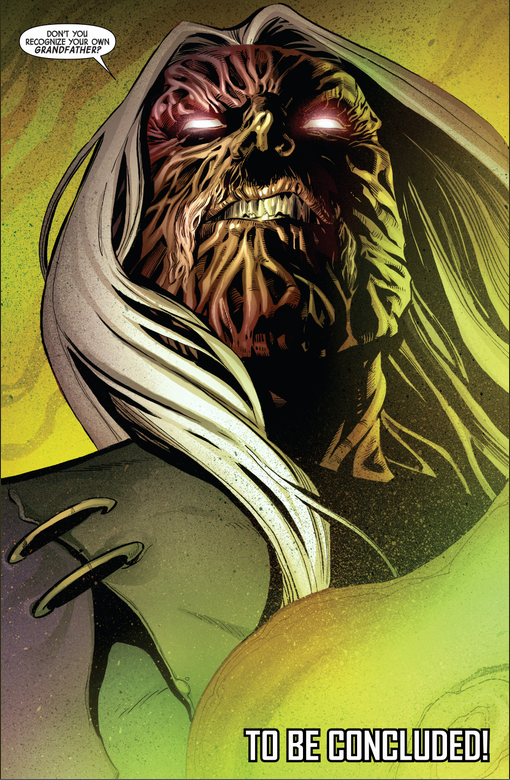
Towards the end of this fight, she pulls off the gas mask he wears. Note that I said he only deflects Synapse's moves, he doesn't actively strike her. It turns out that was meaningful. Following removing his mask, she falls to the ground, staring up at him, shocked, disbelieving what she sees. We turn to a final reveal splash page to reveal (dun-dun-duuuuuun!) her grandfather. Oh. Kay. I bet that would be a better reveal if we knew enough about Synapse for this to feel significant. We only just started getting insight into her personality. We as readers need some sort of understanding into her background in order for this to feel significant. In the past three issues, even just a couple throw away lines here or there about a troubled or broken home since the Terrigen bomb would have set this up beautifully. Fitting in one mention in her date with Pietro and again when she heals the baby, both scenes where the subject of family is either directly mentioned or inferred would have been a great opportunity to set up a good three-beat that would have been paid off here. Instead, we have a reveal that goes out of its way to tell us it's significant without feeling significant.

The most the title has come to establishing this connection is the fact that they are the only two characters thus far who have been given inner monologue narration boxes. Admittedly, I grasping at straws because I want to believe the writer made some effort at being clever with his construction when it's honestly more likely a happy accident. This book can barely maintain its own straightforward narrative from issue to issue (and last time, it gave up halfway through), so I doubt it has the sense of subtle nuance required to form character parallels with its dramatic structure.

I will give this issue credit where it's due, though. As much as I've harped on Stegman's ability to render people (which he kind of fails to do, but he has a future in rendering dolls, action figures, mannequins, and androids), he makes up for it when tasked with rendering body horror (intentionally). That final page with a full beauty shot (meaning it's a close up, not that it's beautiful... although everything is someone's kink) of the Shredded Man is pretty freaking awesome. He's so, for lack of a better term inhuman in his appearance. His skin gone, his skull replaced by something the dried out bark of a dead tree. It's really difficult to make a botanical man look grotesque and not silly, but this one image sells it, even if it looks like it was made for a different, higher quality book. Yet you can still see just enough of the traces of the more human looking man we first met in the prologue of this arc to justify Synapse managing to recognize him.

For the past couple issues, I think I've been on the fence about this title. It's neither brilliant writing, nor is it utter dreck. And mostly I maintain that stance. However, I feel like the gap between good and the bad is widening, leaving a lot of meh betwixt the two extremes. On the one hand, the structure of this arc feels muddled. The pacing is off, almost as if the writer stopped the narrative dead in its tracks last issue to give Cable an excessively long introduction only to give him another such lengthy introduction this issue. Oh, wait. He did. Bad writer. No cookie for you. But on the other hand, the art of that final pages blows everything leading up to it clean out of the water. If only every page had that level of quality. That's ultimately the problem with the series is that the individual issues feel uneven without really achieving either a high or a low. They have their moments, but I kind of feel like I'm reading a title that's marking time instead of progressing in one direction of the other.


and bad in the title is growing more pronounced. The structure of this story feels off. I think it's fair to say stopping half-way through the previous issue's main story in order to provide Cable with an indulgently long introduction only to give him a second introduction in this issue really disrupts the story's pacing. The middle issues of an arc are never the easiest sell, but Duggan and Stegman

Monday, May 23, 2016

The Retcon Voltron

Confession time: I really thought with the benefits of decompressed storytelling, I could fit an entire contemporary arc into the same length as I write for a single bronze age issue. Wasn't that adorably naive of me? Maybe if I had chosen a title that hadn't begun in the wake of a continuity soft reset, or wasn't dealing with a lot of very complex long-term continuity elements from some very disperate corners of the Marvel Universe, or a character who habitually leans on/over the Fourth Wall, I could have been a bit more succinct. I'm hoping now that I've covered the bigger continuity recaps, I can go through this a lot more quickly. Although, this issue involves a character who is both a time traveler and a member of the Summers-Grey family, so I make no guarantees.

Issue #2 of The Uncanny Avengers (the title is The Uncanny Avengers, which apparently sets it apart as its own title from Uncanny Avengers, volumes 1 and 2) once again has Duggan on the script, Stegman on pencils, and Isanove as colorist. The cover art is honestly pretty good, demonstrating our newly introduced antagonist standing dead center and dominating the tableau while behind him, bathed in an eerie purple light, the team is being bound and strangled by giant animated vines... including Human Torch, who could burn right through them. That doesn't make sense. I would say this is impressive, certainly better than the plastic mannequin/action figure bodies that we see inside, except that Shredded Man is very much a case of body horror. And I don't do well with body horror. I think it's gross and excessive, and makes my skin crawl within the context of horror cinema, so I'm less inclined to appreciate it in a superhero team adventure book whose tone doesn't come anywhere near warranting it. The emaciated limbs I could deal with, but seeing his torso and what appear to be his organs spilling out from underneath his cloak really upsets my stomach.

There's kicking it old school, then there's Nokia flip phones...
The issue starts off with Steve hanging out on the rooftop of the Avengers Theater listening to a news update on the situation his team is dealing with in Boston on the radio when his cell phone starts to ring. It's interesting to note that both pieces of technology are significantly outdated. He has Nokia flip phone, for crying out loud. A FLIP PHONE. I enjoy touches that remind the reader that no matter how long he's been here, he's still a man out of time and isn't quite as tech-dependent as the rest of us. But on the other hand, in Marvel's weird floating timeline, it's been somewhere between 10-15 years since he's been unthawed. He's good friends with Stark and has been the Director of SHIELD. I would have thought by now he'd have developed an appreciation of the value of a data phone in his line of work.

Old Cap isn't the bastion of hope he once was.
Comes with age...
Speaking of Stark, guess who's on the other end of the line? We see Tony doing his favorite non-alcohol-or-combat-or-sex related activity: looking smart by pressing buttons on holographic screens. He too has been keeping abreast of current events and asks if he should have his team suit up. Steve says if the Unity Squad can't handle this, it might be time to call it quits, but wants to give them a chance. Yeesh. For one of the biggest symbols of hope in Marvel, that sounds awfully pessimistic. Although, considering has had three volumes in four years, I completely understand the need for contingency planning.

There's a time and a place, Synapse...
In Boston, the Unity Team are being overwhelmed by the hostile flora and demon dogs dominating wreaking havoc on the city. Rogue attempts to get Synapse to use her abilities to shut the demon dogs down, but they don't have brains for her to tap into. When Rogue asks if she's sure, Synapse asks why Rogue doesn't trust her. Instead of giving into this invitation to in-fighting, Rogue asks Synapse to explain how her powers work, to the benefit of the reader. From the explanation given, it sounds very much like she can read and manipulate bio-neural electricity, which I think is what I guessed last time I covered these guys.

She can heal the sick and talk to animals.
She's a magical sword away from being She-Ra.
Conveniently the two are approached by a woman and her child who have been infected with... whatever has turned Boston into Day of the Triffids, but haven't been able to get to a hospital because of the Floral Apocalypse. The mother looks like she has a nasty infection. Her hands look a little gnarled and her face is covered in greenish brown pockmarks. Then Synapse looks into the baby carriage and we find out that the mother got off pretty easily, in comparison, as her little cabbage patch baby is literally halfway between cabbage and baby. Synapse uses her powers to reverse the effects of the infection of the baby by boosting her immune system, then Quicksilver rushes them to the hospital.
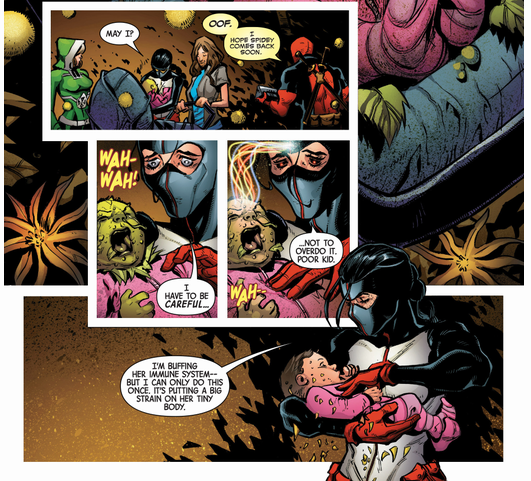

My understanding and appreciation of Synapse's powers grow increasingly more muddled the more I think about this move. I understand that her powers allow her to read and control the brain and neural electricity, and that the brain effectively regulates the entire body's functions. I'm not pretending that either of those facts are unknown to me. However, compared to what the reader has seen Synapse do thus far, this is a dramatic leap that makes her abilities seem less superhuman and more godlike. The team newbie demonstrated in only her second appearance that she quite literally that she cannot only control and rewrite people's minds, but also has the potential to have powers over life and death. I'm not saying that it wouldn't have been an interesting development eventually, but that would be something I'd like to see slowly evolve over the course of a few arcs.
Count Reed bids you velcome to his castle. 
The crux of his arc, such as it is.
Deadpool is suggests setting a (Human) Torch to the entire city, but Rogue points out that it wouldn't be good for civilians, while Brother Voodoo shows how the killer plants are converting by-standers into their food source. Human Torch's focus is elsewhere as we cut to a memory of Reed Richards... without ever seeing Reed. Okay, that's certainly one way of visual storytelling... It's basically an entire page of Johnny Storm in various panels. Remove the word balloons and this could have been about anything. Although Reed's shadow (or maybe Gary Oldman's Dracula shadow) is in one of the panels, so at least we know he's there. Although, I wouldn't be surprised if it was etched in an afterthought after the original art was completed. Additionally, it doesn't even earn its place. The long and short of it is that Reed tells Johnny someday might not have Reed around to do all the science. His resolution to the lack of science doers is to grab an infected civilian and fly off.

She isn't getting paid enough
(or at all) for this shit.
Annoyed, Rogue comments that either she or Johnny should have quit. Yeah, the theory that they had a relationship in the 8 month gap is becoming more textual. Quicksilver has made his way back and tells the remaining Unity Team members that there is someone they should meet, and blazes a trail for them to follow, ignoring Rogue shouting for him to wait up.
Rogue and Wade would make a good buddy roadtrip comedy.
Meanwhile, Johnny touches down on the campus of MIT to recruit a team of scientists to help in their cause. That is his major arc in this story. The epiphany that deserves its own page-long flashback is that Johnny realized that there are more eggheads where Reed came from. Yay?

Wade is at his best when he's
kind of the worst.
Back in Boston, Rogue is exasperated that her team members keep on blazing off without waiting to confer with the group, let alone wait for a leadership command. She asks if they'd act that way for Cap and wonders if it's because she's a woman. I think it's hilarious actually kind of hilarious considering she an X-Man functioning in an Avengers world. The X-Men historically have been profoundly better at being gender balanced both in terms of power sets and command ability, whereas the Avengers really tend to forget about eras with strong female leadership, especially since teams post-Avengers Disassembled did away with elected chairpersons, resulting in Cap and Iron Man being cemented as the designated leaders in the collective consciousness. So as paranoid as her question may sound, it's also valid.

Deadpool counters that maybe it's because she's a mutant. Because Deadpool is the master of being both the best and worst person in the room. While this fun bit of banter is going on, Synapse tries to get in contact with Quicksilver using her pseudo-telepathy, but only gets radio silence.

Suggested Team Name: Los Leafadores
Meanwhile, Shredder The Shredded Man interrupts a news update from the mayor outside her office flanked by his Chia Zuul dogs and two pod people. Remember that poor security guard at the end of last issue that was woefully unschooled in the ways of superhero and creepy villain's lair tropes? Now we see what becomes of those who fail to do the homework. He and some other uninformed rent-a-cop have been coopted, turned into a plantman golem. It just goes to show you, when your city is besieged by a disaster of either supernatural or comic book super science variety, do not approach strange cloaked persons in shadowy lairs. It will not end well for you. Also, remember the poor woman's green baby? She looked pretty much how these guys do. If Synapse hadn't stepped in, would an infant plantgolem be crawling around doing Shredder's bidding?

Even with the latest retcon, Pietro can't help
making battles about his (non) daddy issues.
                                                                      His plant patrol assaults the film crew while he corners the mayor. He seems very focused on how humanity has been taxing the Earth's natural resources, which is a valid complaint for an environmentalist to have and would certainly not sound out of place on an episode of Captain Planet. However, threatening to turn humanity isn't a message that even Wheeler would have supported. As he says this, he's holding her by the face and within two panels, she has turned green, presumably killing her. For a newly minted villain, he has a flair for the dramatic, because as he finished his pronouncement, the dome of the mayor's office blasts off as a giant tentacle/vine monster springs forth, knocking the remaining building to rubble to make way for it.

Where's the Southern Poverty Law Center when you need it?
              He continues on about his evil plan of evilness when he gets knocked down by a Quicksilver sucker punch. Quicksilver has the upper hand and uses it to trade barbs (and remind the reader how glad his is that he so isn't Magneto's kid) when a vine creeps up and slices open his neck. Pietro tears it away and tells the Shredded Man that things will go a lot better for him as he lunges forth, but suddenly is stricken with paralysis. Shredded man gloats and taunts Quickie's mutancy, saying "I try not to feed my darlings junk food... but just one bit of gene trash can't hurt." Okay. villainy is one thing, racism is another. I want this guy mulched never to return. As he says this he is putting Quicksilver in a pod. When Quicksilver protests, Shredded Man says "That's just the hallucinogens talking. You're already dead," as the pod seals itself shut.

So, is she a living image or a gif  file with 10 positions?
What happens next? I have no idea, but I can tell you that in the 70 year time skip, things apparently went to hell in an handbasket after Boston failed to maintain its quarantine and was the first city destroyed. A figure we totally can't see, but has seems to have time traveled here, has a big metal arm, and couldn't possibly be Cable is conversing with what appears to be a sentient tattoo of a WWII-era bombshell pinup girl on his metal arm. She goes by the name "Belle" and is quite the fiesty A.I. program, unafraid to give him a hard time even while complying to orders. In that regards, she reminds me of Friday (or maybe F.R.Y.D.A.Y), Stark's new A.I. in the MCU now that J.A.R.V.I.S. has become the Vision.
Are they in a relationship?
How does this work?
They chat back and forth about whether this was the M-Pox or if the Kree would terraform the planet but not claim it, all the while never panning up from totally not Cable's feet. This mysterious time traveler with a metallic arm uses telekinesis to navigate through the inhospitable terrain. I'm just stumped-- who is this guy?  He guns down a Zuul chia dog with his improbably large plasma gun (why aren't they dropping any clues?) and we finally see an over the shoulder shot of him and can make out the white hair and glowing eye of... oh, who could it possibly be? How many issues will go by before we find out who this mystery man is?!

He finds a newspaper that just happens to be from the day of the Avengers appearance there and has somehow managed to survive outside of archival preservation and still pictures Quicksilver and Deadpool in vivid color AFTER SEVENTY YEARS. Then suddenly the big reveal of our intrepid mystery man as... whaaaaa? Cable?! Great googly moogly, what a twist!!! Oh, and of course they include a big title drop using the cubed lettering from his header of solo titles, just in case we didn't get it. Good grief.

It occurs to me that some readers might not be familiar with Cable, since to my knowledge he has only had a small handful of cameos in the 90s animated series, and the fact that for some readers, X-Men TAS seems as old as Superfriends does to me. Okay, understandable. I was going to try to keep this entry brief, but since clearly I already failed at that task, I might as well. But keep in mind I'm doing a streamlined version. I have to because every other sentence opens up a new can of worms...

My sense of surprise is non-existent. 
Nathan Summers (born Charles Nathan Christopher Summers) was born the son of Scott Summers and Madelyn Pryor, who was a clone of Jean Grey created by Mr. Sinister because he'd been manipulating both the Summers and Grey families' bloodlines in order to birth the chosen bane of Apocalypse, and he wasn't going to let Jean dying on the moon get in the way of generations of planning. Following some Mutant Soap Opera that brought Jean back into the picture and turned Madelyn into a demonic villainess before getting her out of the picture, Nathan was being raised by Scott and Jean until Apocalypse infected him with a techno-organic virus, giving making his left arm and eye a cybernetic appearance. Then he was taken into the future by the high priestess of a cult who later turned out to be his own half(ish) sister from a defunct timeline in order to help him... Okay, let's try this again. Cable is Scott and biologically Madelyn's/Jean's adoptive son who was raised in a far distant post-apocalyptic future by an elderly version of his other-dimensional half sister (plus Scott and Jean in rental bodies) to be the messianic figure of a cult dedicated to overthrowing Apocalypse because he was genetically engineered for that specific purpose by Mr. Sinister. He is an incredibly powerful psi-talent, but usually doesn't use get to show it off because he generally uses it to fight off the techno organic virus that turned his left arm, shoulder, and the area around his left eye appear cybernetic. He is a time traveler and a career soldier and is so grizzled he could give Sam Elliot a run for his money. In recent continuity (as far as I know), Apocalypse is dead, so spent 16 years raising hopping around the timestream and Hope Summers (who herself was a messiah for mutant-kind) while playing cat and mouse with Bishop, has been cured of the TO virus, and uses a cybernetic casing around his arm to compensate for the chicken wing that was left over after he was cured.

My question now that Cable has landed as a protagonist in this series is where exactly are we in his personal timeline? Cable is a very messy character to write in general because, as the paragraph above might indicate, he is basically a bunch of retcons that pulled a Voltron and joined together in order to take human form. Especially considering he bodyslided in from a distant future, we really have no sense where he is relative to our knowledge of his history, let alone whatever might have transpired if he's from significantly further in his personal timeline than his most recent appearance.

Being the middle chapter in a story is a difficult, thankless job. You don't get to have fun establishing a status quo nor do you have the big battles, the epic smackdowns, or the sense of resolution of the conclusion of a story. This story is no exception, however what seems to be further impairing it is the fact that it seemed like there wasn't enough story to flesh out the issue. Johnny's flashback and trip to MIT contribute very little to the narrative and feel like they were last minute additions to pad out the issue. Cable's sequence also seems like it was written two pages longer than it needed to be to stretch the book to its designated page count. In fact, I would argue that as written, I think it would fit in better as an epilogue to a completed arc, setting up a second arc instead of stopping midstream to insert him into the present one. I honestly think it would be more interesting to see him just pop in during the present and grumble on about how the team done fucked up the future. Especially since I picked up a team book for a reason, I would have preferred that prolonged five pages of interaction to be with the team instead of his A.I., as amusing at Belle may be.   This issue isn't the worst story I've ever read, but it feels like the creative team under-served the main story of this issue in order to give Cable more of a set-up than was actually needed and thus it dragged on, resulting in a very "meh" issue overall.