Showing posts with label Blue Beetle. Show all posts

Wednesday, December 14, 2016

The Passion of the Beetle

I admittedly haven't been active on the blog lately. To be fair, I think most of us have been in either in a state of shock/rage/disbelief for the past month or so. It makes the notion of sitting down to write a comics blog feel about on par with the string quartet playing while the Titanic was sinking, but at least there is something therapeutic in routine. Not that I ever think I'm going to feel like the results of the 2016 US presidential election should be normalized, but I finally found a way to channel that into my work. And that involved remembering why I started this blog to begin with.

Much like seemingly everything we know about how the Trump administration is going to run, DC's Continuity is a fucked up brier patch of confusion. If you aren't already drinking the Kool-Aid, jumping into a DC event is like jumping out of an airplane headfirst only to find out that not only was it parked, but you just slammed your head into concrete. All that's left is headaches, frustration, and the fleeting hope that this might turn out to be an object lesson about life choices.

With that in mind, we turn to DC Comics' 2005 event series, Infinite Crisis. Yes, I know. Another major DC event in which those two words are key components. Buckle up, kiddos. DC likes it's Crises and both DC and Marvel are gaga over the word "infinite" and/or "infinity." I guess the rule of cool is in full effect when you need to fabricate a global/cosmic/multiversal narrative that brings everyone no matter how far-flung they are into the narrative. Hell, Infinite Crisis even got its own sequel a couple years back with Infinite Crisis: Fight For the Multiverse. As much as I give Marvel side-eye for being lazy enough to put reuse event titles and *at most* slap a number on the title to differentiate, at least they didn't give them sub-headings that sound like they'd be suitable for a multi-player beat-em-up game. Actually, I think I'd play that game.

Of course, the Big Two's approach to events in the mid-00s was a lot different than it was in the mid-80s. Not only have maxi series like Crisis on Infinite Earths gone from being a novelty to being an anual/semi-annual standard, but there are also now additional accoutrements involved. Of course, you still have the on-going series that have to tie in to the greater narrative, but now events tend to trigger mini series, and one-shot stories to bolster the main narrative. Which brings us to today's subject: Countdown to Infinite Crisis. This is not to be confused with Countdown to Final Crisis, which is 51-issues long, and weekly and I won't be touching that unless I find myself with a lot of free time and possibly a paid gig.

No, instead Countdown to Infinite Crisis is a one-shot, albeit mammoth-size, story that hopes to catch the reader up with anyone who hasn't been reading the ongoings up until now. Of course, it's confusing when the introductory issue for your story is not actually part of the main narrative and isn't even part of the same series. When you are on a website like Comixology or diving through back issue boxes, this issue is a separate listing. Unless you were picking these issues out when they were first hitting the stands or if it is incorporated into the collected edition, the casual reader is still going into the main series blind.

I was originally going to pin it as a cheat, since the actual first issue of the actual story was not actually part of the series (books that start with a "zero" issue also teeter on this precipice), but the more I think about it, this is a series failure.

When beginning a narrative, there are two crucial moments: Point of Attack and Inciting Incident. The Point of Attack is the moment the writer chooses  to start the story. The Inciting Incident is the event or decision that causes the problem of the story. Depending on the writer's preference and the needs of the story, they can be simultaneous. The inciting incident can predate the start of a narrative, by hours, days, even years. The Inciting Incident can even happen after the Point of Attack, which is how you often see it diagrammed in your average high school English class text book. These are all acceptable options in storytelling.

What isn't an acceptable option? Writing a Point of Attack, but not making it part of the same narrative. Imagine seeing a version of Hamlet that started *after* the prince met with the ghost of his father was not only cut from the production, but also staged as an independent production, even though it isn't a complete narrative unto itself. Then again, we do live in a world where film studios thought The Hobbit had enough meat to it to warrant three separate films, so maybe I'm a minority voice in a chorus full of stupid.

And even though I've opted to include this as part of the latest stretch of blogging sessions, I'm going to afterwards try my hardest to act as though I've never laid eyes on this. In fact, considering this is nearly triple the size of an average comic, I'm going to breeze through it as quickly as possible. I might just be pointing out stupid shit more than actual important things because I'm going to play the fool and think "why wouldn't they cover this information again in the actual story?!"

We start off, 20 minutes ago according to the captions, with the Blue Beetle, Ted Kord, is sneaking into a building via the air duct system. His narration tells us that fellow leaguers like Batman and Captain Atomgenerally feel that his heart is in the right place, but his brain is not. Translated: he's probably going to get himself in trouble.

This place he's sneaking around in has one of your traditional supervillain headquarters standards that  I honestly cannot get behind: the giant computer monitor. If this were meant for mass viewing, such as training henchmen in classes (note to self: research henchmen new hire workplace training videos). But no. This looks like it's just the giant-sized monitor for someone's personal desktop. And judging by the desktop wallpaper, this is clearly a shadowy organization of some kind. Based on the icons on the bottom of the screen, it's keeping tabs on all the *other* sketchy organizations floating around the DCU. I guess that includes the Justice League because the first file BB seems to open is Batman's dossier.

Of course, I'm always a bit shaky on how many other Leaguers are privy to whose civilian identities in a given era, so I'm not entirely certain if he's simply shocked that the Knight Chesspiece Society (Knightswatch?) has intel on the secret identities of the Justice League or is he even more shocked to discover that one of the greatest superheroes in the world, JL co-founder, and one of the default JL leaders is actually the renowned womanizing, slacker trustfund baby (or "billionaire playboy," as is the popular idiom). Imagine finding out that one of the Kardashian sisters was a high-ranking Navy Seal. And not Khloe or the mom-- one of the younger ones you pretend to remember the names of. Yeah, you'd be shocked, too.

The next scene suggests that the writer doesn't grasp the concept of a "countdown" because we go from "20 minutes ago" to "four days ago." Ugh. That's not how time works, guys! Whatever.

Kord is meeting up with Barbara Gordon on her jet (I'm assuming Bruce owns any number of parent companies or just fake businesses that fund her or perhaps the Birds of Prey are heroes for hire) because Babs is one of the few people who will hear him out. Plus she's someone he's into despite her lack of interest. Yeah, Teddy boy is a virtuoso of the world's smallest violin and a bit of a creeper "niceguy." How long is this issue again? Ugh.

I don't know if it's relevant yet, but as he enters the plane, Barbara skyping with her fellow Bird of Prey, Black Canary, who suspects that their line is tapped. I'm bookmarking that in case it's important or just establishing Black Canary.

Oracle concludes that somehow Wayne Enterprises has siphoned off nearly all of Ted's company funds and dispersed it across several businesses, meanwhile OMAC is running around using his credit card. So yeah, apparently one of the best scientific minds of the DCU needed to turn to a technopathic hacker to figure out he's an identity theft victim. I'm starting to understand why everyone else crosses the street when they see Kord coming. He's probably that guy who would fall for the "IRS" phone scammers.

It turns out OMAC is just a cover for Kord's BFF, Booster Gold. He's from 500 years in the future and doesn't have an SNN and thus can't get a bank card, so I guess letting BG have a spare debit card was his way of doing him a solid. However, after decades of stories in which characters would relocated from different time periods or different realities, I'm sure the superhero community has a workaround for this sort of problem by now. Hell, even if they don't, Kord has his own company. He could have made a few phone calls and had someone cook the books to set his buddy up with a new identity, then set him up with an entry-level job within the company so he can actually provide for himself. I honestly feel bad for Booster Gold for having such a shitty friend who is either so stupid or so egotistical that he'd rather give his bestie handouts than a job.

After waxing nostalgic to the tune of the world's tiniest violin reprise about how during their JL tenure, they were rookies among giants and felt like they could never measure up (ye gods, do I not care), Blue Beetle meets up with Moocher Booster Gold. Booster. After the two have some totally heterosexual manfeels, Kord admits to his own financial problems, Booster suggests he seeks out the expert on money laundering and corporate takeover, Max Lord.

Max Lord (a version of him is on CW's Supergirl has so little impact in his scene that at first it struck me as baffling that they chose to include it. He gives some phoned in sympathy and brush-off lines like "I'll look into it," but the line that ends up sticking with Ted is "Your best days in tights are behind you. You need to stop looking backwards and start looking forwards."

I find it odd that the word choice was "in tights." Aside from the fact that "tights" is probably a pretty basic cut among the superhero community, there are plenty of bright opportunities, these gentlemen can have in tights. They are both trained combatants with accomplished athletic abilities. They could go on to have successful careers in gymnastics, ballet, or even American Gladiators.

Having arrived at a dead end with Max, Booster says he needs to go take care of his own business. What would that be? An audition for a commercial he needs to interview for. Yeah, that's what he's maxing out Kord's credit card for-- airfare for the audition. You'd imagine he would prioritized helping out a bit more, considering he's effectively a dependent, but no. In this story, Booster Gold is basically that guy who has been crashing on your couch for two months and his idea of helping out around the house is limited to making sure there is a clear path from the sofa to the bathroom, the fridge, and the area immediately around the entertainment system.

By now, you'll notice that the book has a bit of a pattern in its storytelling. That initial scene inside the secret organization's super computer provides the basic framework, with Blue Beetle pulling up their intel and footage of a given character and then transitioning to a flashback in which during various parts of Blue Beetle's investigation, he turns to each of them for assistance or at the very least moral support only to be met with some variation of "sorry, bro, not my problem." The book tends to divide itself into chapters with each character he visits being one of the dossiers on the computer. Chapter 1 is actually a bit of an outlier from this formula because we end with Batman.
Batman: DC's loner who is on every team.
Master of no social skills

Batman's scene does a fairly good job at helping to illustrate what's been going on in the greater DC universe as well as within Batman's solo series without taking the focus off Blue Beetle. The scene starts with a Gotham Gazette headline about what was then a new player in town by the name of the Red Hood. Ted's tendency to yammer on in the course of his one man pity party not only grates on the measured and taciturn Batman, but it also triggers him at the mention of Dr. Light. No, not the awesome MVP from the original Crisis, we're back to the first guy because #THISISWHYWECANTHAVENICETHINGS.

Based only from what I remember from a youtube video from Zeus only knows when, Batman is salty because the JL's Zatana erased Light's memories and when Batman objected, she wiped his memory of the incident, too. Of course, with Batman's default mode being both paranoid and right to be paranoid, he figured out what they did pretty damn quick and so now Batman is on strained terms with the League. Oh and he's actively spying on them now. Sounds about right.

Chapter 2 focuses on Superman, but it also folds Hal Jordan into it. Somehow, despite having a nearly 70-page run, there wasn't room for him to have his own focus. It's odd how the icons on the computer set it up. It includes the Justice League's Big Seven (Batman, Superman, Wonder Woman, Green Lantern, The Flash, Martian Manhunter, and Aquaman), plus Shazam/Captain Marvel. In-universe these are all characters that are legends even among the superhero community. You'd think each of them was set up for their own focal section.

Low angles: emphasize the package size
in order to show dominance
But no. Green Lantern is folded into Superman's focus and he more or less functions like the messenger in a Greek tragedy would. He bids our protagonist greetings, gives him Guy Gardner's regards (I'm assuming this was thrown in because editorial insisted they use Hal even though Guy actually would have had a connection with Blue Beetle) and when Superman arrives on the scene, he relays some bad news. That is the limit of Green Lantern's appearance in this story. What he actually reports is of interest, though-- 100 lb of  kryptonite has been stolen from Kord's last remaining warehouse (again, that pesky violin). I wonder if it's the same supply that Red Hood stole from Black Mask over in the "Under The Red Hood" arc?

As for Blue Beetle's interaction with Superman, well, it seems that despite being a superhero for ages at this point and having been on presumably a few lineups with him at this point (most notably around the Death of Superman), you'd think he'd be able to keep his shit together around him, treat Superman as he would any other peer. Instead, he fangirls out a bit, somewhere between being star-struck and intimidated. Granted, Superman is a big deal in-universe, but so are just about all the other heroes he interacts with in this book.

It's an interesting character beat, but this sense insecurity around Superman doesn't add to the narrative at all. The thrust of the scene is Blue Beetle being unable to confide in Superman despite himself when Hal's report more effectively pulls Clark's focus and provides him with a reason to fly
Fun Fact: Joker has groupies other than Harley.
off before Kord can say much.

After this latest round of fail, Blue Beetle is set upon by a group of hired goons called the Madmen, who look like they were designed to look like muscular Joker henchmen. He is rescued by Booster Gold, who has inexplicably ditched his all-important audition and donned the uniform he swore he could never wear again.

Subtext: you're all fucking sheep!
Chapter 2 ends with one of the most delightful scenes in the book which doesn't tie into the narrative at all, but I'm hoping it plays a big part in the main series. It involves the Injustice Society, Dr. Light wanting retribution for having his memory erased, and Black Adam basically being the Namor of DC comics.

On a related note, chapter 3 starts with Beetle looking into Captain Marvel's background before flashing back to Kord's house. While he is at his computer trying to suss out who is siphoning off his fortune, he and Booster Gold are wondering if Ted could possibly weaponize the mystic beetle scarab that he had inherited from the original Blue Beetle... and a science hero weaponizing magic is a fun story idea. Booster, being a man from the future who thinks the internet is about on par with legos, tells Kord to step aside and let him have a shot at the computer and KA-BOOM. Yeah, The computer explodes. That happens. And it totals the house in the process. I know this is happening in a world where Kryptonians, Amazons, homo magi are running around, but that there is what threatens the delicate suspension of disbelief of this story.

Kord gets his buddy and his scarab out in the burning wreck and rather than seeing if Booster gets to the hospital safely, considering the universe has it out for them lately, he instead decides to seek out Captain Marvel. Unfortunately, Billy Batson is busy being a first tier character, so in lieu of him, Kord is met with the cryptic advice of an all-wise wizard who thinks that a 12-year-old is emotionally mature enough to handle being the living embodiment of seven divine beings. The Wizard Shazam really doesn't have the patience for Kord's whining, so he casts Teleport, sending him away but leaving his scarab in the cave.
Princess Leia Syndrome: crushing on the
girl who treats you like a little brother

Chapter Three: Wonder Woman/Martian Manhunter. We flash back to a a mission earlier in the day.
And KA-BOOM. Yeah, this time it's Kord airship, Bug, that explodes. I'm starting to think he must have cheated death at some point before this and now we are in a comic book adaptation of Final Destination.

Kord wakes up in the infirmary of the JL's moonbase, the Watchtower. Wonder Woman has been looking after him. Again, there is little meat to her scene. She's more supportive than Batman or Superman were, but that's all that can be said about it. Her scene also commits a heinous sin of storytelling by having Ted Kord recap a lot of what has happened so far. Granted, this sucker is 70 pages long, but come on, give the reader some credit.

And once again, she finds a reason to leave without really helping. Though, this is probably the least motivated exit thus far. Despite him being at an incredible low point and their station having access to an instantaneous teleportation system, she has to go to the embassy now. Okay. I am starting to suspect everyone enters an interaction with Blue Beetle with an exit strategy. We all have that friend we dread getting stuck talking to and for the *entire* DC superhero community, it seems to be Ted Kord. He has to be Lt. Reginald Barclay of DC Comics.

Of course you weren't included in the psychic APB-- you're in the room with him!
Kord makes his way from the infirmary to the main operations room of the base, where Martian Manhunter is on monitor duty. Manhunter is also on the more supportive side, albeit more distantly and objectively. Still, he does listen to Kord's problem, which is more than Bats or Supes did. Kord almost manages to get him to pull in some extra help to investigate when Adam Strange, protector of the planet Rani (which I'm assuming reads as a white savior narrative, but in SPAAAAACE), calls in with a dire request for aid, as Rani is being invaded by Hawkman's people, the Thanagarians. Yeah, remember how I said this book is good at hinting at the breadth and scope of the DCU? Case in point. Well, so much for help from Martian Manhunter. He gets to recruit some a-listers and potential fan favorites to go play Star Wars.

As he wallows alone in self-pity, he takes a closer look at the goggles of his uniform which had been scratched up in his fight with the Madmen only to discover that they had actually bugged him suing a piece of Booster Gold's robot buddy who was thought to have ditched him for a trip back to the 25th Century. He manages to track it back to a remote castle-- which brings us back to the supervillain lair with the giant computer screen.

And the worst thing you can ever do is read someone's private files on you. I can attest, I once read an old audition form from college and whoever was casting definitely scribbled "is terrible" on it. Yeah, it can be a blow to the ego. But enough of my woes. Their file on him says "DECEASED." Yeah, that's quite a few degrees more troubling.
Celebrity death hoaxes are the worst
It's at this moment, when he turns around to discover the mastermind of all his woes, as well as a cadre of armed henchmen, has been in the room with him for a while. Why do these heroes never notice villains and their goons sneaking up on them? To be fair, his costume covers his ears.
The best evil plans have evil chess-themed titles.
Max Lord's plan is to take down all the meta humans on Earth. This is despite the fact that he himself is a meta human, albeit one with a very subtle talent to influence people. Also, based the dialogue, I get the impression that the writer isn't well versed in DC mythology, which lumps all super-powered beings into the category of meta-humans, which are more akin to DC's answer to Marvel's mutants than anything else.

Lord actually wants to recruit Kord, since Kord has no superpowers, only his own natural physical and scientific acumen. You know how NOT to foster the sense of loyalty you'd want in a potential recuit? Ruining his business, by siphoning and dispersing his funds and stealing from his warehouses, blowing up his inventions, blowing up his home, blowing up his best friend... all of these are great ways to show people how bad a boss you'd be.

Max Lord's Plan B, it turns out was if you can't beat 'em, shoot two bullets in his head.

So, yeah. That's how this issue ends.

I don't know what to say about this issue. It had three talented writers on the project, Geoff Johns, Greg Rucka, and Judd Winick. And despite three writers, there is barely enough story here to justify a 30-page story, let alone one over twice that length. The book had two missions and it only sort of accomplished the one that justifies its existence, namely to line up the various story threads from the ongoing series that will coalesce to form the story elements of the event. Instead, they gloss them over a bit, but they seem like distractions from the story the book wants to tell: the Passion of Ted Kord.

Yeah, I know that's the title of the entry, but it's not out of laziness that I'm hearkening back to it, but emphasis. This book is all about putting Blue Beetle through his paces, which is the role of a decent dramatist, but I think they break the character in order to enable the story they want to tell. The Ted Kord from the post-crisis Justice League titles is a lot more buoyant and confident than the one presented to the reader here.

I almost feel like his entire journey in this story is meta-commentary on the comic book industry's tone problem as creators kept trying to work dark, grim, and gritty character traits into characters who were neither created with that intent nor allowed to organically evolve to it. DC honestly suffers this problem more than Marvel because they earnestly try to maintain the classic, iconic, wholesome images of their heroes, but at the same time when the sales numbers dip, they will go boldly in other directions even if it results in severe tonal whiplash. Hence, we are presented with a story in which a character whose MO is so patently Silver Age that in the face of the modern era of storytelling, he reads as pathetic and ineffectual and his only recourse is a suicide mission for the sake of maintaining his values. When read from that lens, this becomes not only a dark story, but also some wicked commentary on the nature of the comics industry in 2005.


Wednesday, May 25, 2016

Supergirl's last gleaming

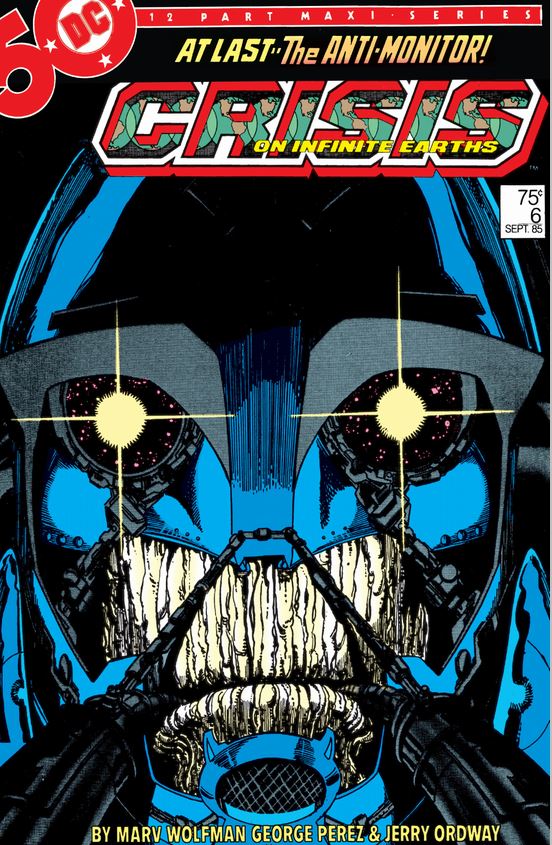
One of comics' most iconic covers.
Before I say anything else, I think after slogging through the first 6 issues of this series with my opinions of them being decidedly in the mixed category, I can happily say that this issue was fantastic. It's focused, has a sense of purpose, and has a sense of stakes and consequences that feel real. More importantly, I felt an emotional reverberation that the first 6 issues honestly lacked. The previous issues all seem like they are constantly at risk of buckling under the weight and scope of the sprawling narrative that ranges across time, and space, and realities. With this issue, however, the story zeroes in on characters in a way it hadn't before. Oh, don't get me wrong, the gratuitous size of the cast is still there, but the POV doesn't shift quite so often. But I'm getting ahead of myself. Back to the old beat-by-beat...

Lyla and Alexander are floating around in space on an asteroid. Lyla is pretty much tapped as far as powers and Alexander is pretty much being kept to the rear for some sort of final trump card because he is made of both matter and anti-matter. Pariah appears insists that Lyla must know why the Monitor set up his “eternal life/appear at mass misery” powers. She says she does and says that perhaps it is time for explanations, but first she tells him to take the three of them to earth, where “all will be enlightened.”

Cut to Earth-S, home of Captain Marvel, Mary Marvel, Uncle Marvel, and presumably Fetus Marvel. Also, an anthropomorphic tiger because Earth-S is the best place in the DC Multiverse.
This looks like the beginning of furry slash a beautiful 
friendship.
Two characters I’m assuming are part of Captain Marvel’s rogues gallery are having a discussion. Sivana is your run of the mill 50’s mad scientist. Short, bald, round glasses, lab coat. Ibbac seems to be his designated hired muscle. Big, not too bright, doesn’t wear a shirt (very hairy chest—woof),and has a short proto-mohawk. Sivana thinks he’s ahead of the curve. He tells Ibbac of his plan to take over all five Earths before anyone knows what has happened. Captain Marvel appears, totally interrupted the supervillain monologue because I’m assuming Captain Marvel, his alter being only a kid, lacks proper superhero/villain etiquette. Before that gets too far Sivana and Ibbac vanish.

The Murky and Lurky of Earth-S
             
We see that Psycho Pirate’s hold on the heroes of Earth-4, Earth-S, and Earth-X has dissipated and they’re playing nice with the Earth-1/Earth-2 heroes who were sent there to help.

Meanwhile, the heroes of Earth-2 commiserate over their maimed comrade, Wildcat. They are secretly observed by someone who was on the scene when it happened, Yolanda Montez. She seems to know who his secret identity is. Her thought bubbles say she regrets never having told him about her own powers and regrets that they would have made a good team. In this issue, she has donned his costume, which really must have been taken in to be such a snug fit on a woman. She’s the new Wildcat. If this proves important is anybody’s guess.
The Exposition station has been downsized to Exposition asteroid.

               Back to the whole universally-significant plot, Lyla, Alexander, and Pariah have gathered up six characters, one from a different Earth, only five of them from a still extant Earth: the Superman of Earth-1, the Superman of Earth-2 (the older one), the Blue Beetle of Earth-4, Lady Quark of Earth-6 (the sole survivor), Uncle Sam (yes that Uncle Sam) of Earth-X, and Captain Marvel of Earth-S. Also, Alexander is from Earth-3 and Pariah is, safe to assume, not from one of the main Earths either, but the writers seem to have forgotten that. Lyla is telling these representatives the big explanation in the hopes that they will explain it to the rest of the population of their respective earths.
Elections were not held, I'm taking it.
Ages ago, there was only one universe and the people of the planet Oa (distinguished by their blue skin, white hair, and penchant for robes) were the sole residents (or sole residence of consequence) and were an immortal, scientifically advanced utopia. That is… until one of them who is selfish about his scientific discoveries, named Krona, scienced too hard and created both the Evil Anti-Matter Universe and the multiverse. Oa seems to be the only planet without duplicates in the other dimensions with the exception of the exception of the EAMU, where it is known as Qward (Oa being the one from the Positive Matter Universe). As punishment for his actions, Krona is turned into immortal incorporeal energy… because no comic book character has ever come back from an eternal prison or anything like that. Oh, when he’s sentenced he’s totally saying “you will suffer for this,” putting him firmly in General Zod territory.
   The Oans get hypervigilant about maintaining the integrity of the multiverse and anti-matter universe, since one of their own was responsible. At first they created the Manhunters, which were machines, but later abandoned them in favor of creating the Green Lantern Corps. [Quick case of backtracking for something I forgot to mention in an earlier recap. GL John Stewart and other corpsmen have been having trouble using their rings. A trip to present-day Oa in issue 5 or 6 revealed that the Guardians are trapped in a stasis field. These two facts will probably tie into this somehow.]
The GLC’s rings are powered by an energy source the Oans generate. I don’t see how this really fits into the multiverse, since the GLC acts more like intergalactic cops than interdimensional ones. But I digress… Not all Oans were satisfied with the GLC, which led to an Oan civil war, resulting in half the Oan population to an alternate dimension, where they built destructive weapons and evolved into a race known as “The Controllers.” I’ll hazard a guess and say they’re bad news.
I wonder if they shrank and went nearly bald as a species from dealing with the likes of Kilowog.
               Over the course of the millenia, it's probably important to note, they evolved from fairly  humanoid with blue skin into blue yoda-sized guys. 
Anti-Monitor might as well be a space zombie.
               On the moons of Oa and Qward, respectively, the Monitor and Anti-Monitor sprang into being. The Anti-Monitor took control of Qward and created an army of “thunderers” (no idea what those are), the elite among them he changed into the shadow demons who have been plaguing the heroes on the various Earths in the COIE series thus far. With these, he conquered the EAMU.

            Meanwhile, the Monitor was basically going the route of asceticism—meditation and learning the secrets of the universe. Running out of things to conquer, Anti-Monitor sensed the Monitor across the multiverse, recognizing him both as his other self and as something to be conquered, resulting in a million years of stalemated warring between them until they both blasted each other into a very long comatose state for 9 million years. It turns out that Pariah was the one who woke the Anti-Monitor. He considers it 1 of 3 of the sins he must atone for. Thought we were done with the info dump? Ah, such optimism…

Unreliable narrator?
           Pariah can’t even tell us which Earth he’s from, it’s just a foggy memory for him. Like most of the major players riding COIE’s backstory asteroid, he was a brilliant scientist who created wonders that damn near created a perfect world—he was like Jesus, DaVinci, and Caesar Augustus all rolled into one. Then he discovered the existence of the multiverse, which was frowned on by his people because they have a damnation prophesy regarding learning the origins of the universe, but he (like most comic book scientists, I now realize) is made up of 99% hubris. He builds an anti-matter chamber to explore the multiverse and destroyed his universe in the process because matter and anti-matter cannot co-exist. Whoops.
This is what we in the professional world call a "whoopsie daisy."

       He was kept alive in solitude for 1 million years. The explosion of his world caused the Anti-Monitor to awaken and feed upon the energies of Pariah’s world, making him stronger and more powerful than the Monitor.
To Summarize Pariah’s Three Sins:
1.      Exploding his own universe.
2.      The Explosion awakening the Anti-Monitor.
3.      The Anti-Monitor increasing his powers by feedings on the energies of the exploded universe.
Conclusion: So, he didn’t really commit three sins. He committed one sin that had compounded levels of bad results.
               Lyla chimes in to mention that he also woke up the Monitor. Silver linings… Being more proactive this time, and made Pariah into a being with the ability to sense and be drawn to dimensionally cataclysmic events and he would follow Pariah to them. But with every universe the Anti-Monitor destroys, the Monitor’s powers wane. The Monitor looked for heroes to aid in his mission and in the process, he found Lyla as a girl drowning at sea and takes her as his own and raises her as his daughter.
Isn't this the same backstory for Fury and/or Troia?
Pretty homogeneous origin story for Amazons not named Diana, huh?
                Now that we’re done this, Lady Quark is about ready to pounce on Pariah for his part in all this, but Captain Marvel holds her back while Uncle Sam exhorts them all the band together instead of resorting to in-fighting. Master strategist, that Uncle Sam…
Calling her "ma'am" is actually kind of charming.

               Next, we are treated to a page where each row of panels includes different heroes across different Earths are discussing their situation, having presumably been caught up on the details. Earth 1: Spectre, Deadman, and The Phantom Stranger are having a meeting of the Spooky Club. Earth 2 has Power Girl and Huntress [sidebar: Earth-2’s Huntress is the daughter of Bruce and Selina Wayne and she’s all kinds of cool].
Possibly a callback to Supergirl and Batgirl's scene from issue #4
Earth-X has clearly the most important characters ever: a pink “Dead Pirate Roberts” lookalike named Firebrand, a guy in a hazmat suit named Human Bomb, and Dollman. He seems to be about 10”, wears red ankle boots, and Dr Strange’s cape. Earth-4 has Blue Beetle, who must have since returned from the Exposition Asteroid, talking to Nightshade and Peacemaker. Earth-S features the Marvel family worrying about Captain Marvel, but it cannot go without saying how fun it is to see Beast Boy, who was one of the Earth-1&2 characters sent there last issue,  fluttering about as a pterodactyl, as is appropriate behavior for any megamorph when extinction is nigh.

               We return again to the Storytime Asteroid, where a large fighting force of heavy hitters has been gathered. It is explained that while Pariah can go to the next cataclysmic event, he can’t take people with them (that time he teleported Lady Quark to safety must have been a one-time deal), so Alex, being composed of both matter and anti-matter is the residential transit macguffin of COIE. Monitor instinctively knew this, which is why he sent for him in the first place. Sidebar, Alexander has grown to manhood and has a curly red mullet. Alexander opens a portal and the narration compares it to the parting of the Red Sea.
Christ imagery is heating up.

In this moment, Alexander, who like Kal-El, was put into a rocket as a baby and shunted off into space in order to avoid a genocidal event, officially becomes more of a Moses analogue than Superman. Pariah spells out what he said a page ago by saying that as part of his atonement, it’s his job to lead the heroes to the Anti-Monitor.
Moses powers are a go!
               The assembled heroes fly through the “cosmic membrane” and the narration is in full congratulatory tones. You can almost hear the intense orchestral John Williams music playing in the background. They arrive at fortress that looks like an ancient near eastern ruin floating in space. The heroes regard it as having never seen anything like it.
An evil lair as built by an ant colony.
               Inside, Anti-Monitor knows all, sees all and wants Psycho Pirate to use his powers to enslave the oncoming heroes, however, PP is tapped out from having used his abilities on the entire Earths of three different realities. Anti-Monitor is most displeased and smacks PP around before deciding it’s time to take matters into his own hands.
I get the feeling that Prof Stein is fucking with him.
               The heroes enter the outermost extremes of the fortress. Characters notice a) their powers don’t work here the same way as they do back in their world, b) they got into the fortress way too easily, c) they’re all feeling afraid of what is to come. Light appears in the mouths and eyes of the gargoyle-like statuary of the fortress and the very stone and mortar of the building shapes itself into limbs and stone golems assaulting the heroes. Lady Quark is beseeching the spirit of her husband to help her blast their foes to pieces. Earth-2 Superman is shocked to discover himself bleeding following a direct hit—Kryptonians, it seems are vulnerable here. They are barely holding their own. The only hero who seems to have an edge is Captain Atom. And it’s not even that great an advantage since his ability to smash them to bits is counteracted by their ability to reform themselves.
This either raises the stakes or belies the color of the sun.
               The party is split in the chaos. Superman-1 is looking for Pariah. Pariah needs to forge ahead along with Dr. Light while Superman-2 holds off the stone golems. Pariah is crushed by the very infrastructure of the fortress seconds before Superman-1 catches up. Timing is everything. Dr. Light suddenly has a really good focal point for her pent up irritation. “The Anti-Monitor is going to pay,” and flies off. She didn’t get the memo about Pariah’s immortality, but Superman did. He’s not entirely certain if she’s a hero or villain, but she seems to have the morally right agenda, so he chases after her.
Dr. Light has mastered both English and empathy in a short time.
               Supes reaches DrL. She’s vengeful not stupid, so she waited for him outside a chamber containing a solar collector, a massive machine she deduces Anti-Monitor is using to reduce the vibrational differences between the Earths. He asks if she’s certain. Come on, Clark. You’re a reporter. She’s got a PhD. A PhD in Science. Omni-disciplinary comic book science. She’s got this. She wants to take this tech home to study, but Superman is feeling pretty punchy. Before either can act on those urges, Superman is hit from behind with a powerful blast of bright white energy. His pain is so intense and so visceral, his scream appears as a sound effect instead of a word which Supergirl hears with her superhearing and flies off to his aid knowing full-well that she might be killed by something that can cause Superman to scream that way. Again, the narration might as well be giving the superheroes one big collective blowjob. EVERYTHING IS EPIC.

And I am not using that word lightly. Everything from this point and forward in the issue is worthy of viking songs or Klingon opera. The narration is beautifully purple and gives this half of the issue the emotional weight is richly deserves.
Idealism vs 80s grim-dark
               Anti-Monitor is smacking Superman around. Dr L intercedes and declares how murdery she’s feeling. Anti-Monitor either freezes her or teleports her away in an honestly cool looking silhouette panel. Supergirl catches up with Pariah, who senses tragedy is about to unfold and Supergirl rushes forth, determined to save her cousin, determined to take up the torch for him if she fails to save him.

           She catches her foe by surprised and gets in a few good punches, thrashing him about as she harangues him over all those lives now lost. He smacks her away sending her flying into a wall with only one hit. She grabs the stone floor and literally rips it out from under him, then resumes wailing on him and destroying his “life shell,” and destroying the solar collector in the process.


               Anti-Monitor’s proverbial kid gloves are off and he transforms into a creature of glowing red and white energy as he declares, “You, your cousin, your friends, your worlds all shall die with you!” The fortress shakes and Supergirl tasks Dr. L (whom she manages to really impress, which should not going unmentioned) with getting Clark out of there to safety and getting the heroes out of the EAMU. She flies directly into the glowing form of the Anti-Monitor, smashing him and soon she is consumed, glowing like the same red energy.
She turns around, telling Dr. L to make a run for it and Anti-Monitor takes the advantage, killing her. Without a body, that took a lot out of Anti-Monitor. He blasts off screaming “you’ll pay for this next time” like a Captain Planet villain.
               The building is crumbling to bits. While the rest of the heroes regroup out front, Superman-1 is still in the solar collector chamber surrounded by Dr. L and a few others, holding the dying body of Supergirl. She tells him how much she loves him and was inspired by him until her final breath. Superman-1 assumes the “scream at the heavens” position declaring he’ll kill Anti-Monitor for this while Superman-2 comforts him and preaches against vengeance for Supergirl’s sake.
               The fortress is still crumbling (it’s like quicksand—it really does take a while) and they need to escape before Alexander’s powers give out. They don’t want to end up like the Egyptians at the end of The Ten Commandments and that Red Sea is a bitch to get caught in. They fly back through, Superman-1 still carrying his cousin’s body.

EPILOGUE
               The five Earths are no longer at risk of destroying each other and the weird time anomalies have stopped, but they’re still interlocked and frozen in time and space.  A memorial is held in Chicago on Earth-1, news coverage airing. Batgirl delivers a eulogy intercut with images of the Daily Planet folks watching from their offices as well as heroes from multiple earths mourning for her in attendance.
               Superman takes her body, wrapped tightly in her cape now repurposed as a burial shroud, to the Fortress of Solitude. He reflects on all the hope and optimism of her when she first arrived on Earth, a young girl of 15 with nothing but her future ahead of her. From there, he takes her body out past Earth’s atmosphere and just lets it float around in the vacuum of space for eternity. Good lord, Superman—cremation is your friend. It wouldn’t surprise me if an alien villain had found her body and used it to reverse engineer an anti-Kryptonian weapon or zombifies her. Minor Spoiler: However, that didn’t happen. After this event, Supergirl is literally erased from existence. She never happened. That heroic sacrifice is utterly trivialized and her heartfelt requiem is obviated from memory.


DC probably didn’t realize quite what a “fuck you” it was to their audience, but it was hardly their last. As meaningful as the second half of this issue was, DC’s perennial tug of war it has between its need to sustain the iconic status quos of their major character and its creative teams’ need to have the space to tell new stories is one that invariably results in the status quo winning out. The impact of the stories they don’t tell are immaterial compared to the wills of an often capricious EiC. Part of what was decided when Crisis was planned was that they decided that there was simply too many Kryptonians running around, which diminished both the mysterious nature of Krypton and the isolated “god amongst men” aspect of Superman’s character. Of course, this didn’t last because nobody remains editor in chief forever. Jay Edidin of Jay and Miles X-plain the X-Men (listen to them, they are one of the best comics podcasts out there) once pointed that you can tell what the status quo was when a new editor-in-chief first started reading by what regressive changes s/he makes. However, inevitably, the next wave of creative talent comes into the different with a different status quo crystalized in their minds and can just as readily make their own resets in whatever contrived methods they choose based on a precedent that has its root right here. Such mentality in creative leadership is capricious and cyclical, and really puts on display creators’ unwillingness to grasp the fact that continuity and characterization marches on and their job is to be the torchbearers and not the gatekeepers of modern myth.

Despite that angry rant, I have to say that this issue is without a doubt the best so far in the series.  The issue does carry out some of my grievances from before during the first half of the issue, but it synthesizes them into something more cohesive. There is still a massive weight of DC cosmology exposition, but the writing doesn't try to fight against it like it has in previous issues. Yes, the Pariah and Lyla's exposition from the dawn of time is unwieldy, but it's finally providing some real, concrete answers so that the reader is finally given some solid footing in the narrative instead of just being told that the destructive force is the bad guy. Yes, there are the cast of thousands, but we most of them are largely left in the background and we narrow our focus on only a handful of characters so we feel engaged in the narrative. Then, once the narrative transitions to the raid on the anti-matter universe, the narrative transcends into something that truly feels epic, the narration becomes swells with the purpleness of its prose and you realize pretty quickly that out of the fodder of the first six issues has risen a truly standout piece of work that is a match for its iconic cover. Wolfman and Perez hit their stride with this series when they realized that one character's emotional experience and self-sacrifice and the resonance of her loss is more potent storytelling than checking in with hundreds of characters we don't have time to invest in. Taken out of the context of what came after, this is probably one of the most moving and earned comic book deaths I've ever read.

Wednesday, May 18, 2016

Mandatory Sidequesting

In today's installment, we look at issue #6 of Crisis on Infinite Earths, once again from the creative team of Marv Wolfman and George Perez. I think it's fair to say that thus far I've been underwhelmed so far. As much as I find the weird little continuity wonks amusing, it's not enough to make up for the the lack of narrative focus, the pretty needless padding, or the conspicuous fingerprints of editorial mandate. Today's issue has all the problems we've seen before, but I think it starts to move past them by the end of the issue. I wouldn't call this a 180 turn-around, but it is a good sign of improvement.
The cover of issue #6 doesn’t excite me. It is visually interesting, as it is a gruesome-looking cosmic android/cyborg and well-drawn, but it really doesn’t tell me anything about the issue I’m about to read. In fact, it really feels like this was alternate artwork for the Anti-Monitor's big reveal from the end of issue #5, which to be fair is a valid reason to make him a focus of this issue's cover.. But to what end?  What new information does this communicate to the reader? That he's scary? I think we figured that out at the end of last issue. A close-up of Dracula can also be frightening but it doesn't tell the story the way an image of him him lunging at a victim or recoiling from a crucifix-wielding Van Helsing would be. Perhaps if he had been rendered in a medium shot, actually doing something in a way that is visually interesting and dynamic that also give us a hint of what is about to unfold in this issue, I'd feel differently, but as is, it's a portrait, not a cover.  Perhaps, if I hadn’t already read the preceding issue, that might draw my attention, but since I did, all it does is offer me a second look at the big reveal from last time. The Anti-Monitor, this time in a beauty shot. The tag on the issue reads, “At last… the Anti-Monitor.” Well, at least the cover delivers on its promise.

Anti-Monitor:
Master of the sick burn
Such great "show, don't tell. You don't even need Anti-Monitor's villain monologue...
               The splash page teases us with the issue title, “3 Earths, 3 deaths!” We are in the Anti-Monitor’s base. Now, not only can we see our principle protagonist, but we can see their surroundings as well. Maybe the Anti-Monitor didn’t step out of the shadows. Maybe he just found the light switch. Now that Psy-Pi can actually see his master, his focus on Flash seems to be waning. Flash needs only to wait for the right moment. Psy-Pi begs Anti-Monitor for the vast amount of emotions he has been promised. Without failing to go into detail about how loathsome he finds Psy-Pi, he concedes, filling him with cosmic energy that seems to expand Psy-Pi’s consciousness in the process.
Never change, Kimiyo... 
               We cut back to the heroes’ base, where the ship is a’rocking and on the verge of destruction. It makes me wonder how the Anti-Monitor was about to do so, since I believe it’s in the Monitor’s netherverse along with Earth-1 and Earth-2, and thus beyond his reach. The characters are all trying to get their bearings and rescue any that might have fallen from where they’ve been. Hawkman rescues Dr. Light and she rewards him for his efforts with verbal abuse because she’s the bestest.

              Another character who is continually vying for the title of best character in the crossover is Changeling (or Beast Boy, I forget what his codename is at this point). Though honestly, I think if you gave half the lines he has had thus far in Crisis, it wouldn't work. The key to writing Garfield Logan, at least when Wolfman is writing him, seems to be writing him as cocky, over-confident, and more than a little bit of a hornball without ever forgetting that he's a 13-year-old boy with all the impulses and lack of impulse control that implies attempted to emulate what he thinks to be appropriate masculine behavior and failing miserably at it because he is so deeply out of his league in terms of maturity. True, today we'd call it toxic masculinity, but he's always so affable and self-deprecating about it that I'm convinced this is .
She's out of your league? Who? Pick one.
             The space station seems like it’s breaking apart at the seams, turning into more of a hostile death trap with every passing moment. Pariah begins vanishing, realizing he’s drawn to another tragedy. Alexander is tempted to use his matter/anti-matter powers to draw in the three unprotected Earths (not certain if that is his only power, that’s been extremely vague thus far), but Lyla realizes that it is she who must act. She uses her powers to knock Alexander out and teleport all of them to safety, and presumably to their next desired locations on the three unprotected Earths before I ultimately explodes.
And this is the totally non-evil Harbinger you should really be trusting.... 

Time for some interludes. I'm starting to really question why some of the interludes and cameos we keep coming back to exist. Did Wolfman and Perez simply want to give as many characters as possible a moment in the spotlight? Are they being set up in a way that will pay off by the end of the series? Or are these blatant ways to incorporate new characters and plot elements that will be incorporated into the new status quo? Time will tell. 

I bet they bandaged him up with
his boots still on.
On Earth-2, The Atom puts Wildcat to bed. Wildcat’s legs are bandaged up and he is definitely feeling a case of owwies, I find it odd that he's still in full uniform, whereas I'd imagine most any physician would have put him in a medical gown for the examination. Of course, I don't think they explicitly said they took him to the emergency room, so for all I know, someone in JSA headquarters just grabbed all the gauze in the first aid kit and gave him thigh high mummy boots. He has been rendered paralyzed from the waist down after saving his friend Yolanda Montez from Red Tornado’s lightning last issue. Speak of the devil, Yolanda Montez is watching outside from the window… with no shoes on. Where are your shoes, lady? That’s how you get tetanus! Yolanda regrets having never told Wildcat about her own abilities, but resolves to put them to good use in his honor.

Does your method of honoring him include staying out of danger?
Considering he lost his legs keeping you safe...
On Earth-1, or at least Outer Space-1, Lex Luthor is just floating around in his green and purple battle suit, then suddenly gets picked up by Brainiac’s floating head/tentacle ship either through a whirlwind, a tractor beam, or a tractor beam that looks like a Red Tornado fart. The art shows the external view of Brainiac's ship instead of viewing them interacting, most likely because the pages were done before Wolfman and Perez had this mid-Apocalyptic Legion of Doom-esque subplot figured out. Luthor doesn't recognize the enemy of his enemy, but Brainiac clarifies that he is the new Brainiac. I bet they will introduce more iterations sparingly, considering they're only up to Brainiac-5 by the 30th Century. Thus ends that weird bit of Dadaism story thread for the moment.
The new best part of a super-villain team-up
 is NOT seeing them interact
               The next major destination is Earth-X. In later years, DC must have figured 52 was a manageable amount of alternate realities, but for now, it seems that alternate realities were so plentiful that they have exhausted both numerical and letter designations.

A onesie, mohawk, and gladiator sandals. 
And this isn'teven the most remarkable 
instance of bird-themed costuming this issue...
In this reality, WWII waged on for 40 years. God, the entire world’s economy must be deep in the shitter after a war that long. Here we find the Dr. Light, Steel (no, not the Shaq O’Neil one), Hawkman, and, Northwind. I have never seen this character before and if it weren’t for the namedrop, I would have been calling him “Mohawk Bird Boy” for the length of this recap. Unlike the Hawks, his wings are underarm. Whether they are actual wings or just feathery growths on his arms that enable flight are beyond my knowledge, but the important thing is that ridiculously pointy Mohawk. He is definitely a product of this book’s time. Dr. Light is surprised that she now understands what everyone is saying. Northwind suggests that is could be something Harbinger might have done. Lyla apparently can add “universal translator” to her CV. Speaking of which, Steel points out to the horizon and we see her in the sky. No, she isn’t flying in the sky, it’s like she has been projected onto the sky in a blue outline. It strikes me as very “mother goddess.” Oh, and by sky, I meant anti-matter cloud. If any characters still don’t trust her at this point, I wouldn’t question it seeing this. Northwind spots a large mob of people racing towards the cloud. He swoops in hoping to stop them, but they are all in a terrible, frenzied rage and pelt him with rocks.

By golly, we are truly fearsome!
Among this mob are the Freedom Fighters, whose membership includes The Ray, Human Bomb, Phantom Lady, Black Condor, Doll Man, and Uncle Sam. Yes, that Uncle Sam. Ostensibly, they are this Earth’s heroes, but they are acting conspicuously lawful evil at the moment, attacking the delegation of Earth-1/2 heroes. Between that and the horde of violent civilians racing towards oblivion, it can be surmised that something is askew. 

Even if you ignore the personification of the U.S. government on the team, this team at least visually is very odd, at least from the perspective of someone reading nearly 30 years later. Phantom Lady, isn't odd so much as she is just plain noteworthy as being the inspiration behind The Watchmen's Silk Spectre, and the only character to serve as inspiration for the main cast who wasn't appropriated from Charlton Comics. 

The Human Bomb is just a headscratcher to me because at least from what I can visually tell, he is just a guy covered from head to toe in a hazmat suit. And it's a pretty non-descript hazmat suit, compared to Marvel's Hazmat, whose look was very distinct. Then again, this lineup strikes me as having been created at a time when just showing up to fight crime in a hazmat suit you stole from the Springfield Nuclear Plant was sufficient.

He was scheduled to be grand marshal of the BDSM Pride 
Parade before this crisis started
Black Condor's look is amazing. I get the feeling that he gets dressed in the morning not certain whether he wants to cosplay as Storm or go to the Folsom Street Fair. His costume is, as his name implies, all black (and presumably all leather), and consists of a a black (leather) gorget/neck corset and a pair of black (leather) briefs conjointed by one long (leather) harness strap. He has black (leather) mid-calf boots, and a black (leather) underarm cape that connects to black leather manacles on his wrists. I'm just going to go out on a limb as say he's probably a submissive bottom and I actually think it's great that comics has a sex positive fetish enthusiast all the way back in the 40s. Innocent times, I guess. Although, today seeing a member of the fetish community dressed up as BeyoncĂ© would probably be just as adorable. 

Of course, the Earth-1/2 rescue party meets up with the Freedom Fighters and the fists start flying. This is a superhero comic. That's the rule. You might think that this is your classic superhero misunderstanding: punching and quips now, questions later. But no, this is different and the Freedom Fighters don’t seem to be pulling their punches. In a post-Batman v Superman and Captain America: Civil War world (I'm guessing I'll need to share my thoughts on them eventually), a casual reader might just assume superheroes just engage in brutal, no holds barred combat as a matter of principle, but this is not the case. In fact, some of the away team are friends with the Freedom Fighters. But the FF and the rest of their world's population seem to be raving mad, both uses of the word mad being in play.

Soon we see why, as the Anti-Monitor has amped up Psy-Pi’s powers to the extent that he feels like his mind is going to explode. He is still bathed in the light that Anti-Monitor used to empower him, no irises in his eyes and upon a closeup of his face, the three remaining Earths are seen with energy crackling around them. It’s pretty effective, if a bit over the top, which is the series’ calling card.
It'll be like overloading a battery... except with brains splattering on the wall.
On Earth-4, Martian Manhunter, Jay Garrick, Katana, a golem-like man named “Blok,” and a winged guy I think might be Earth-2’s Hawkman arrive and start surveying the terrain. Possibly Hawkman flies up to get a better view when the Blue Beetle’s ship, Bug appears overhead and Possibly Hawkman is bombarded with an energy blast with an atomic energy signature. The assailant, Captain Atom flies from Bug, accusing them as the ones who kidnapped Blue Beetle in the first issue of the series.
This is your sandbox, Wolfman & Perez.
           I shouldn't be the one telling you how this works.
Again, Marv Wolfman really sucks at his own continuity, let alone DC’s big, sprawling multiverse, so why is he in charge of this project? Back in issue #1, The Monitor established that all the heroes he assembled were from Earth-1 and Earth-2. Were they making this up as they went along? It's not like they could have not known he wasn't from one of their main universes because half what what this entire project was explicitly attempting to accomplish was to fold characters from the various extraneous licenses DC had acquired into the main universe. After all, Wolfman stated in the forward to the Absolute Edition of Crisis that he researched continuity for years before writing and certainly an editor would have caught that right? That is... unless Wolfman was editing his own work. Sigh. Of course.
It looks like that partnership in Nite-Owl and Rorschachs' backstory
was inherited from their spiritual ancestors.

Even so, while the footnotes establish that this Blue Beetle was the one recruited by Harbinger, Blue Beetle’s account doesn’t quite add up, making it sound like all he’d experienced was an ominous story, but for some reason knows that the heroes sent here are there to destroy his world. This since the story’s internal continuity is clearly fucked to hell, so I’m just giving up and going with it. What is clear is that the denizens of Earth-4 are under the same malevolent influence as on Earth-X. From here on in, it’s a repeat of the previous scene. Heroes battling decidedly irrational villains with blatant name-drops just in case we need them. Additional Charlton characters include: Nightshade, Peacemaker, Judo Master, Thunderbolt, and The Question (sidebar: play a fun game of "spot the Watchmen analogue in this scene), who seems to be the only character native to Earth-4 who has caught on to the fact that their very emotions are being manipulated to self-destructive ends. Meanwhile, Harbinger can again be seen on the horizon.
Which is the bigger mystery: where'd they go or who the fuck is she?
We take a break from the same damn basic story on the three unsecured Earths to visit rapidly merging Earths-1 and Earth-2. Under the sea and Aquaman and company are despairing because as the Earths draw closer to merging, their cities are getting displaced, replaced with Earth-2’s version of the landscape as their vibrational walls thin out. Sea Master and Black Manta watch Aquaman at a distance as they plot sinisterly. In turn they are being watched by a white haired girl in cut-off shorts named Dolphin (who seemingly is all on her own and lacks her memories), but then they suddenly disappear. I’m betting Sea Master and Black Manta are ending up with Brainiac’s crew. I doubt Dolphin will be relevant to the story again.
Um... what's to stop people from going around that thing?
Finally, we are at the third padding tactic unsecured reality, on Earth-S. Supergirl, Changeling and Kole from the Teen Titans, Wonder Woman, and Black Canary in a truly unfortunate ensemble (I’m going to start a running tally on best and worst costumes in this series) make up this away team. Again, there is a huge throng of people making a beeline for the anti-matter, but Kole uses her apparently crystal-based powers to throw up a gigantic sheet of crystal around the opening of the field. Of course that makes me wonder if the field is stationary or will absorb the crystal in a few minutes and render her efforts moot.
The Marvel Family: action    
figures sold separately
I don’t know what else Fawcett Comics had to offer, but they most certainly did have one big nut on offer: Captain Marvel, better known today as “Shazam” for the purposes of copyright laws. I’m going to ignore the whole “blah blah blah they’re under mind control” recap because that’s a given at this point. I know the idea of a boy who turns into an adult superhero is silly by today’s standards, but I didn’t know just how splendidly silly it got until I espied his sidekicks: Mary Marvel, Captain Marvel Jr, and the resplendent Uncle Marvel. Ye gods, we’ve reached a new plateau of hokey. I don't know what's sillier-- the Marvel family or the fact that Mary Marvel and Captain Marvel Jr seem to be a match for Wonder Woman, but are no match for Black Canary's track suit. Thank you for this moment, Wolfman & Perez!


Dea ex Machina
One more Earth for Olympic Rings Formation...
Oh! And there’s Harbinger in the sky again! We’re cutting fast and furious between the fighting on the three earths, but Harbinger is up to something, becoming increasingly more prominent on the page until the energy crackling, around her starts to draw in the three universes before Anti-Monitor and Psy-Pi realize what she’s doing. When her task is complete, she glows white, vanishing in that glow. She re-appears once again as plain old Lyla. Alexander informs us that she expelled every bit of her powers as Harbinger to complete her task and now only Lyla remains. They’ve spared Earths-4, S, and X from the Anti-Monitor, but the other problem has been compounded. Now there are five universes vibrating ever closer to one another.

On Earth-2, Power Girl, Johnny Quick, and Green Lantern are working with villains, Star Sapphire, Per Degaton, and Deathbolt. Suddenly all three of those villains vanish into thin air. Hm. I wonder where they possibly could have ended up…? Lyla and Alexander float around the netherverse on an asteroid, pondering their next step. Back in Wildcat’s hospital room, Yolanda has made some alterations to his costume and leaves, once again by window, taking on his mantle as the new Wildcat.
My thesis for this installment is that DC is positively riddled with animal-themed
superheroes with bafflingly dumb looks. Ye gods, that muzzle...
Whereas last issue felt like a waste of time, stalling for a big reveal, this issue had its own set of drawbacks. I wouldn’t mind the “side-quest” nature to rescuing the other three Earths if it weren’t for the fact that I felt like the issue devotes a lot of time to showing us the same story three times. Perhaps it wouldn’t have felt so rough if they had managed to interweave the stories on the three different Earths a bit more, intercut the action instead of feeling like we’re reading the same sequence three time with three sets of characters. I do get why the creative team felt the need to namedrop all the characters from each of the imported companies. After all, if they are going to be folded into the new Earth, might as well get to know them. However, three separate “getting to know you” fights really made this issue feel painfully repetitious. Then again, it did spare me from having to devote a lot of time recapping. This is my shortest recap so far and a good quarter of it is basically talking about industry practices. Then again, I think the sausage factory details are more interesting than the actual meat in this instance.
This has nothing to do with anything, but I'd feel like I cheated you if I didn't let you know this happened.